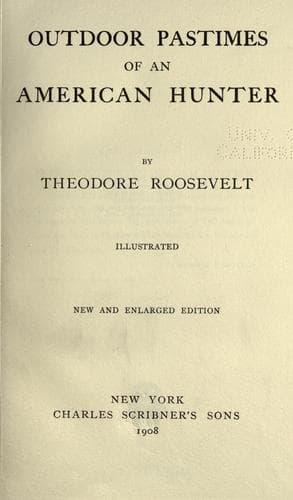
Outdoor pastimes of an American hunterRoosevelt, Theodore
General
Outdoor pastimes of an American hunter
Roosevelt, Theodore
Hunting -- United States; Hunting -- West (U.S.)
When in the Bad Lands of the Western Dakotas the late September breezes
grow cold, then the bucks, their horns already clean of velvet which
they have thrashed off on the bushes and saplings, feel their necks
begin to swell; and early in October—sometimes not until November—they
seek the does. The latter, especially the younger ones, at first flee in
frantic haste. As the rut goes on the bucks become ever bolder and more
ardent. Not only do they chase the does by night, but also by day. I
have sat on the side of a ravine in the Bad Lands at noon and seen a
young doe race past me as if followed by a wolf. When she was out of
sight a big buck appeared on her trail, following it by scent, also at
speed. When he had passed I got up, and the motion frightened a younger
buck which was following two or three hundred yards in the rear of the
big one. After a while the doe yields, and the buck then accompanies
her. If, however, it is early in the season, he may leave her entirely
in order to run after another doe. Later in the season he will have a
better chance of adding the second doe to his harem, or of robbing
another buck of the doe or does which he has accumulated. I have often
seen merely one doe and one buck together, and I have often seen a
single doe which for several days was accompanied by several bucks, one
keeping off the others. But generally the biggest bucks collect each for
himself several does, yearlings also being allowed in the band. The
exact amount of companionship with the does allowed these young bucks
depends somewhat upon the temper of the master buck. In books by
imperfectly informed writers we often see allusions to the buck as
protecting the doe, or even taking care of the fawn. Charles Dudley
Warner, for instance, in describing with great skill and pathos an
imaginary deer hunt, after portraying the death of the doe, portrays the
young fawn as following the buck when the latter comes back to it in the
evening.[4] As a matter of fact, while the fawn is so young as to be
wholly dependent upon the doe, the buck never comes near either.
Moreover, during the period when the buck and the doe are together, the
buck’s attitude is merely that of a brutal, greedy, and selfish tyrant.
He will unhesitatingly rob the doe of any choice bit of food, and though
he will fight to keep her if another buck approaches, the moment that a
dangerous foe appears his one thought is for his own preservation. He
will not only desert the doe, but if he is an old and cunning buck, he
will try his best to sacrifice her by diverting the attention of the
pursuer to her and away from him.
Footnote 4:
While the situation thus described was an impossible one, the purpose
of Mr. Warner’s article was excellent, it being intended as a protest
against hunting deer while the fawns are young, and against killing
them in the water.
Public-domain text, read in full here on John Shaqi.
Reviews
Reviews
No reviews yet
Be the first to share your thoughts on this work.
Elsewhere in the archive
Join the Discussion
Join the discussion
Sign in to leave a comment or review.
Sign InorCreate an account