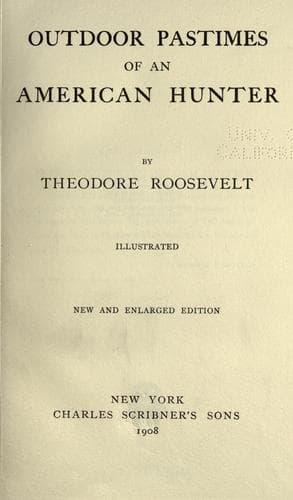
Outdoor pastimes of an American hunterRoosevelt, Theodore
General
Outdoor pastimes of an American hunter
Roosevelt, Theodore
Hunting -- United States; Hunting -- West (U.S.)
By the end of the rut the old bucks are often exhausted, their sides are
thin, their necks swollen; though they are never as gaunt as wapiti
bulls at this time. They then rest as much as possible, feeding all the
time to put on fat before winter arrives, and rapidly attaining a very
high condition.
Except in dire need no one would kill a deer after the hard weather of
winter begins or before the antlers of the buck are full-grown and the
fawns are out of the spotted coat. Even in the old days we, who lived in
the ranch country, always tried to avoid killing deer in the spring or
early summer, though we often shot buck antelope at those times. The
close season for deer varies in different States, and now there is
generally a limit set to the number any one hunter can kill; for the old
days of wasteful plenty are gone forever.
To my mind there is a peculiar fascination in hunting the mule-deer. By
the time the hunting season has arrived the buck is no longer the
slinking beast of the thicket, but a bold and yet wary dweller in the
uplands. Frequently he can be found clear of all cover, often at midday,
and his habits at this season are, from the hunter’s standpoint, rather
more like those of the wapiti than of the whitetail; but each band,
though continually shifting its exact position, stays permanently in the
same tract of country, whereas wapiti are apt to wander.
In the old days, when mule-deer were plentiful in country through which
a horse could go at a fair rate of speed, it was common for the hunter
to go on horseback, and not to dismount save at the moment of the shot.
In the early eighties, while on my ranch on the Little Missouri, this
was the way in which I usually hunted. When I first established my ranch
I often went out, in the fall, after the day’s work was over, and killed
a deer before dark. If it was in September, I would sometimes start
after supper. Later in the year I would take supper when I got back.
Under such circumstances my mode of procedure was simple. Deer were
plentiful. Every big tangle of hills, every set of grassy coulees
winding down to a big creek bottom, was sure to contain them. The time
being short, with at most only an hour or two of light, I made no effort
to find the tracks of a deer or to spy one afar off. I simply rode
through the likely places, across the heads of the ravines or down the
winding valleys, until I jumped a deer close enough up to give me a
shot. The unshod hoofs of the horse made but little noise as he shuffled
along at the regular cow-pony fox trot, and I kept him close into the
bank or behind cover, so as to come around each successive point without
warning. If the ground was broken and rugged, I made no attempt to go
fast. If, on the other hand, I struck a smooth ravine with gentle
curves, I would often put the pony to a sharp canter or gallop, so as to
come quickly on any deer before it could quite make up its mind what
course was best to follow.
Public-domain text, read in full here on John Shaqi.
Reviews
Reviews
No reviews yet
Be the first to share your thoughts on this work.
Elsewhere in the archive
Join the Discussion
Join the discussion
Sign in to leave a comment or review.
Sign InorCreate an account