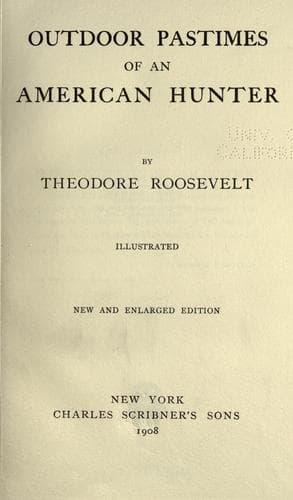
Outdoor pastimes of an American hunter — John Shaqi
Outdoor pastimes of an American hunterRoosevelt, Theodore
General
Outdoor pastimes of an American hunter
Roosevelt, Theodore
Hunting -- United States; Hunting -- West (U.S.)
The average writer, and for the matter of that, the average hunter,
where cougars are scarce, knows little or nothing of them, and in
describing them merely draws upon the stock of well-worn myths which
portray them as terrible foes of man, as dropping on their prey from
trees where they have been lying in wait, etc., etc. Very occasionally
there appears an absolutely trustworthy account like that by Dr. Hart
Merriam in his “Adirondack Mammals.” But many otherwise excellent
writers are wholly at sea in reference to the cougar. Thus one of the
best books on hunting in the far West in the old days is by Colonel
Dodge. Yet when Colonel Dodge came to describe the cougar he actually
treated of it as two species, one of which, the mountain lion, he
painted as a most ferocious and dangerous opponent of man; while the
other, the panther, was described as an abject coward, which would not
even in the last resort defend itself against man—the two of course
being the same animal.
However, the wildest of all fables about the cougar has been reserved
not for hunter or popular writer, but for a professed naturalist. In his
charmingly written book, “The Naturalist in La Plata,” Mr. Hudson
actually describes the cougar as being friendly to man, disinterestedly
adverse to harming him, and at the same time an enemy of other large
carnivores. Mr. Hudson bases his opinion chiefly upon the assertions of
the Gauchos. The Gauchos, however, go one degree beyond Mr. Hudson,
calling the puma the “friend of Christians”; whereas Mr. Hudson only
ventures to attribute to the beast humanitarian, not theological,
preferences. As a matter of fact, Mr. Hudson’s belief in the cougar’s
peculiar friendship for man, and peculiar enmity to other large beasts
of prey, has not one particle of foundation in fact as regards at any
rate the North American form—and it is hardly to be supposed that the
South American form would alone develop such extraordinary traits. For
instance, Mr. Hudson says that the South American puma when hunted will
attack the dogs in preference to the man. In North America he will fight
the dog if the dog is nearest, and if the man comes to close quarters at
the same time as the dog he will attack the man if anything more
readily, evidently recognizing in him his chief opponent. He will often
go up a tree for a single dog. On Mr. Hudson’s theory he must do this
because of his altruistic feeling toward the dog. In fact, Mr. Hudson
could make out a better case of philo-humanity for the North American
wolf than for the North American cougar. Equally absurd is it to talk,
as Mr. Hudson does, of the cougar as the especial enemy of other
ferocious beasts. Mr. Hudson speaks of it as attacking and conquering
the jaguar. Of this I know nothing, but such an extraordinary statement
should be well fortified with proofs; and if true it must mean that the
jaguar is an infinitely less formidable creature than it has been
painted. In support of his position Mr.
Public-domain text, read in full here on John Shaqi.
Reviews
Reviews
No reviews yet
Be the first to share your thoughts on this work.
Join the Discussion
Join the discussion
Sign in to leave a comment or review.
Sign InorCreate an account