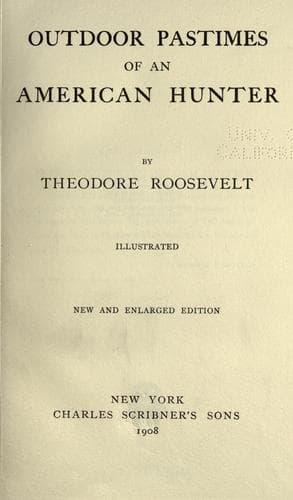
Outdoor pastimes of an American hunterRoosevelt, Theodore
General
Outdoor pastimes of an American hunter
Roosevelt, Theodore
Hunting -- United States; Hunting -- West (U.S.)
Disregarding the Pacific coast form of Vancouver and the Olympian
Mountains, the wapiti is now a beast of the Rocky Mountain region
proper, especially in western Montana, Wyoming, and Colorado. Throughout
these mountains its extermination, though less rapid than on the plains,
has nevertheless gone on with melancholy steadiness. In the early
nineties it was still as abundant as ever in large regions in western
Wyoming and Montana and northwestern Colorado. In northwestern Colorado
the herds are now represented by only a few hundred individuals. In
western Montana they are scattered over a wider region and are protected
by the denser timber, but are nowhere plentiful. They have nearly
vanished from the Big Horn Mountains. They are still abundant in and
around their great nursery and breeding-ground, the Yellowstone National
Park. If this park could be extended so as to take in part of the winter
range to the south, it would help to preserve them, to the delight of
all lovers of nature, and to the great pecuniary benefit of the people
of Wyoming and Montana. But at present the winter range south of the
park is filling up with settlers, and unless the conditions change,
those among the Yellowstone wapiti which would normally go south will
more and more be compelled to winter among the mountains, which will
mean such immense losses from starvation and deep snow that the southern
herds will be woefully thinned.[5] Surely all men who care for nature,
no less than all men who care for big game hunting, should combine to
try to see that not merely the States but the Federal authorities make
every effort, and are given every power, to prevent the extermination of
this stately and beautiful animal, the lordliest of the deer kind in the
entire world.
Footnote 5:
Steps in the direction indicated are now being taken by the Federal
authorities.
The wapiti, like the bison, and even more than the whitetail deer, can
thrive in widely varying surroundings. It is at home among the high
mountains, in the deep forests, and on the treeless, level plains. It is
rather omnivorous in its tastes, browsing and grazing on all kinds of
trees, shrubs and grasses. These traits, and its hardihood, make it
comparatively easy to perpetuate in big parks and forest preserves in a
semi-wild condition; and it has thriven in such preserves and parks in
many of the Eastern States. As it does not, by preference, dwell in such
tangled forests as are the delight of the moose and the whitetail deer,
it vanishes much quicker than either when settlers appear in the land.
In the mountains and foothills its habitat is much the same as that of
the mule-deer, the two animals being often found in the immediate
neighborhood of each other. In such places the superior size and value
of the wapiti put it at a disadvantage in the keen struggle for life,
and when the rifle-bearing hunter appears upon the scene, it is killed
out long before its smaller kinsman.
Public-domain text, read in full here on John Shaqi.
Reviews
Reviews
No reviews yet
Be the first to share your thoughts on this work.
Elsewhere in the archive
Join the Discussion
Join the discussion
Sign in to leave a comment or review.
Sign InorCreate an account