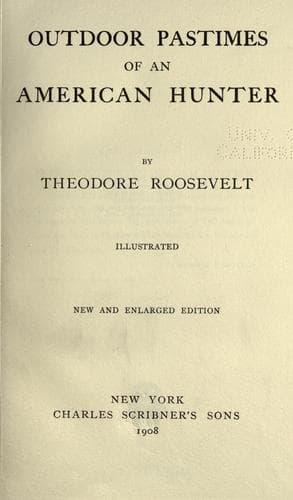
Outdoor pastimes of an American hunterRoosevelt, Theodore
General
Outdoor pastimes of an American hunter
Roosevelt, Theodore
Hunting -- United States; Hunting -- West (U.S.)
The nose of the wapiti is very keen. Its sight is much inferior to that
of the antelope, but about as good as a deer’s. Its hearing is also much
like that of a deer. When in country where it is little molested, it
feeds and moves about freely by day, lying down to rest at intervals,
like cattle. Wapiti offer especial attractions to the hunter, and next
to the bison are more quickly exterminated than any other kind of game.
Only the fact that they possessed a far wider range of habitat than
either the mule-deer, the prongbuck, or the moose, has enabled them
still to exist. Their gregariousness is also against them. Even after
the rut the herds continue together until in midspring the bulls shed
their antlers—for they keep their antlers at least two months longer
than deer. During the fall, winter, and early spring wapiti are roving,
restless creatures. Their habit of migration varies with locality, as
among mule-deer. Along the little Missouri, as in the plains country
generally, there was no well-defined migration. Up to the early
eighties, when wapiti were still plentiful, the bands wandered far and
wide, but fitfully and irregularly, wholly without regard to the season,
save that they were stationary from May to August. After 1883 there were
but a few individuals left, although as late as 1886 I once came across
a herd of nine. These surviving individuals had learned caution. The
bulls only called by night, and not very frequently then, and they spent
the entire year in the roughest and most out-of-the-way places, having
the same range both winter and summer. They selected tracts where the
ground was very broken and there was much shrubbery and patches of small
trees. This tree and bush growth gave them both shelter and food; for
they are particularly fond of browsing on the leaves and tender twig
ends, though they also eat weeds and grass.
Wherever wapiti dwell among the mountains they make regular seasonal
migrations. In northwestern Wyoming they spend the summer in the
Yellowstone National Park, but in winter some go south to Jackson’s
Hole, while others winter in the park to the northeast. In northwestern
Colorado their migrations followed much the same line as those of the
mule-deer. In different localities the length of the migration, and even
the time, differed. There were some places where the shift was simply
from the high mountains down to their foothills. In other places great
herds travelled a couple of hundred miles, so that localities absolutely
barren one month would be swarming with wapiti the next. In some places
the shift took place as early as the month of August; in others not
until after the rut, in October or even November; and in some places the
rut took place during the migration.
Public-domain text, read in full here on John Shaqi.
Reviews
Reviews
No reviews yet
Be the first to share your thoughts on this work.
Elsewhere in the archive
Join the Discussion
Join the discussion
Sign in to leave a comment or review.
Sign InorCreate an account