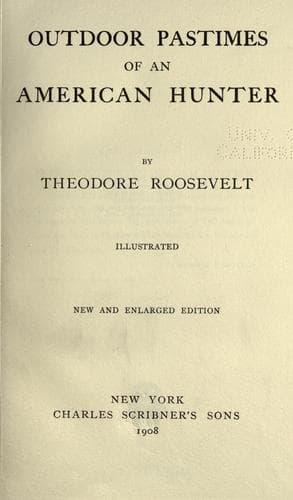
Outdoor pastimes of an American hunterRoosevelt, Theodore
General
Outdoor pastimes of an American hunter
Roosevelt, Theodore
Hunting -- United States; Hunting -- West (U.S.)
No chase is more fascinating than that of the wapiti. In the old days,
when the mighty antlered beasts were found upon the open plains, they
could be followed upon horseback, with or without hounds. Nowadays, when
they dwell in the mountains, they are to be killed only by the
rifle-bearing still-hunter. Needless butchery of any kind of animal is
repulsive, but in the case of the wapiti it is little short of criminal.
He is the grandest of the deer kind throughout the world, and he has
already vanished from most of the places where he once dwelt in his
pride. Every true sportsman should feel it incumbent upon him to do all
in his power to preserve so noble a beast of the chase from extinction.
No harm whatever comes to the species from killing a certain number of
bulls; but an excessive number should never be killed, and no cow or
calf should under any circumstances be touched. Formerly, when wapiti
were plentiful, it would have been folly for hunters and settlers in the
unexplored wilderness not to kill wild game for their meat, and
occasionally a cow or a calf had to be thus slain; but there is no
excuse nowadays for a hunting party killing anything but a full-grown
bull.
In a civilized and cultivated country wild animals only continue to
exist at all when preserved by sportsmen. The excellent people who
protest against all hunting, and consider sportsmen as enemies of wild
life, are ignorant of the fact that in reality the genuine sportsman is
by all odds the most important factor in keeping the larger and more
valuable wild creatures from total extermination. Of course, if wild
animals were allowed to breed unchecked, they would, in an incredibly
short space of time, render any country uninhabitable by man—a fact
which ought to be a matter of elementary knowledge in any community
where the average intelligence is above that of certain portions of
Hindoostan. Equally, of course, in a purely utilitarian community all
wild animals are exterminated out of hand. In order to preserve the wild
life of the wilderness at all, some middle ground must be found between
brutal and senseless slaughter and the unhealthy sentimentalism which
would just as surely defeat its own end by bringing about the eventual
total extinction of the game. It is impossible to preserve the larger
wild animals in regions thoroughly fit for agriculture; and it is
perhaps too much to hope that the larger carnivores can be preserved for
merely æsthetic reasons. But throughout our country there are large
regions entirely unsuited for agriculture, where, if the people only
have foresight, they can, through the power of the State, keep the game
in perpetuity. There is no hope of preserving the bison permanently,
save in large private parks; but all other game, including not merely
deer, but the pronghorn, the splendid bighorn, and the stately and
beautiful wapiti, can be kept on the public lands, if only the proper
laws are passed, and if only these laws are properly enforced.
Public-domain text, read in full here on John Shaqi.
Reviews
Reviews
No reviews yet
Be the first to share your thoughts on this work.
Elsewhere in the archive
Join the Discussion
Join the discussion
Sign in to leave a comment or review.
Sign InorCreate an account