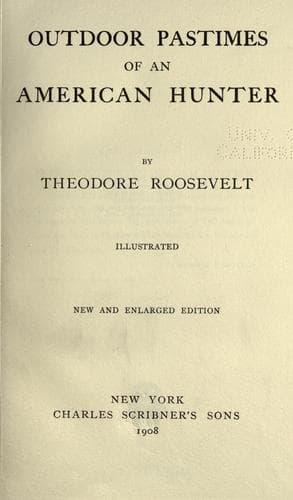
Outdoor pastimes of an American hunterRoosevelt, Theodore
General
Outdoor pastimes of an American hunter
Roosevelt, Theodore
Hunting -- United States; Hunting -- West (U.S.)
In the old days, of course, much of the hunting was done on the open
plains or among low, rugged hills. The wapiti that I shot when living at
my Little Missouri ranch were killed under exactly the same conditions
as mule-deer. When I built my ranch-house, wapiti were still not
uncommon, and their shed antlers were very numerous both on the bottoms
and in places among the hills. There was one such place a couple of
miles from my ranch in a stretch of comparatively barren but very broken
hill-country in which there were many score of these shed antlers.
Evidently a few years before this had been a great gathering-place for
wapiti toward the end of winter. My ranch itself derived its name, “The
Elkhorn,” from the fact that on the ground where we built it were found
the skulls and interlocked antlers of two wapiti bulls who had perished
from getting their antlers fastened in a battle. I never, however,
killed a wapiti while on a day’s hunt from the ranch itself. Those that
I killed were obtained on regular expeditions, when I took the wagon and
drove off to spend a night or two on ground too far for me to hunt it
through in a single day from the ranch. Moreover, the wapiti on the
Little Missouri had been so hunted that they had entirely abandoned the
diurnal habits of their kind, and it was a great advantage to get on the
ground early. This hunting was not carried on amid the glorious mountain
scenery which marks the home of the wapiti in the Rockies; but the
surroundings had a charm of their own. All really wild scenery is
attractive. The true hunter, the true lover of the wilderness, loves all
parts of the wilderness, just as the true lover of nature loves all
seasons. There is no season of the year when the country is not more
attractive than the city; and there is no portion of the wilderness,
where game is found, in which it is not a keen pleasure to hunt. Perhaps
no other kind of country quite equals that where snow lies on the lofty
mountain peaks, where there are many open glades in the pine forests,
and clear mountain lakes and rushing trout-filled torrents. But the
fantastic desolation of the Bad Lands, and the endless sweep of the
brown prairies, alike have their fascination for the true lover of
nature and lover of the wilderness who goes through them on foot or on
horseback. As for the broken hill-country in which I followed the wapiti
and the mule-deer along the Little Missouri, it would be strange indeed
if any one found it otherwise than attractive in the bright, sharp fall
weather. Long, grassy valleys wound among the boldly shaped hills. The
basins were filled with wind-beaten trees and brush, which generally
also ran alongside of the dry watercourses down the middle of each
valley. Cedars clustered in the sheer ravines, and here and there groups
of elm and ash grew to a considerable height in the more sheltered
places. At the first touch of the frost the foliage turned russet or
yellow—the Virginia creepers crimson.
Public-domain text, read in full here on John Shaqi.
Reviews
Reviews
No reviews yet
Be the first to share your thoughts on this work.
Elsewhere in the archive
Join the Discussion
Join the discussion
Sign in to leave a comment or review.
Sign InorCreate an account