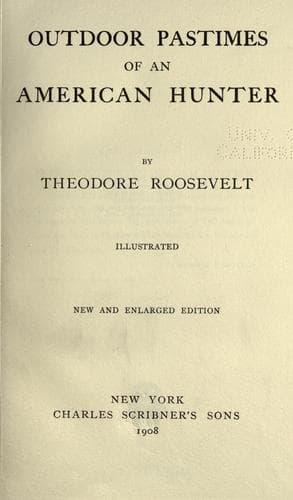
Outdoor pastimes of an American hunterRoosevelt, Theodore
General
Outdoor pastimes of an American hunter
Roosevelt, Theodore
Hunting -- United States; Hunting -- West (U.S.)
Under the cloudless blue sky the
air was fresh and cool, and as we lay by the camp-fire at night the
stars shone with extraordinary brilliancy. Under such conditions the
actual chase of the wapiti was much like that of the mule-deer. They had
been so hunted that they showed none of the foolish traits which they
are prone to exhibit when bands are found in regions where they have
been little persecuted; and they were easier to kill than mule-deer
simply because they were more readily tracked and more readily seen, and
offered a larger, and on the whole a steadier, mark at which to shoot.
When a small band had visited a pool their tracks could be identified at
once, because in the soft ground the flexible feet spread and yielded so
as to leave the marks of the false hoofs. On ordinary ground it was
difficult to tell their footprints from those of the yearling and
two-year-old ranch cattle.
[Illustration:
TROPHIES OF A SUCCESSFUL HUNT
]
But the mountains are the true ground for the wapiti. Here he must be
hunted on foot, and nowadays, since he has grown wiser, skill and
patience, and the capacity to endure fatigue and exposure, must be shown
by the successful hunter. My own wapiti-hunting has been done in
September and early October during the height of the rut, and therefore
at a time when the conditions were most favorable for the hunter. I have
hunted them in many places throughout the Rockies, from the Big Horn in
western Wyoming to the Big Hole Basin in western Montana, close to the
Idaho line. Where I hunted, the wapiti were always very noisy both by
day and by night, and at least half of the bulls that I killed attracted
my attention by their calling before I saw either them or their tracks.
At night they frequently passed close to camp, or came nearly up to the
picketed horses, challenging all the time. More than once I slipped out,
hoping to kill one by moonlight, but I never succeeded. Occasionally,
when they were plentiful, and were restless and always roving about, I
simply sat still on a log, until one gave me a chance. Sometimes I came
across them while hunting through likely localities, going up or across
wind, keeping the sharpest lookout, and moving with great care and
caution, until I happened to strike the animals I was after. More than
once I took the trail of a band, when out with some first-class
woodsman, and after much running, dodging, and slipping through the
timber, overtook the animals—though usually when thus merely following
the trail I failed to come up with them. On two different occasions I
followed and came up to bands, attracted by their scent. Wapiti have a
strong, and, on the whole, pleasing scent, like that of Alderney cattle,
although in old bulls it becomes offensively strong. This scent is very
penetrating. I once smelt a herd which was lying quite still taking its
noonday siesta, certainly half a mile to the windward of me; and
creeping up I shot a good bull as he lay. On another occasion, while
Public-domain text, read in full here on John Shaqi.
Reviews
Reviews
No reviews yet
Be the first to share your thoughts on this work.
Elsewhere in the archive
Join the Discussion
Join the discussion
Sign in to leave a comment or review.
Sign InorCreate an account