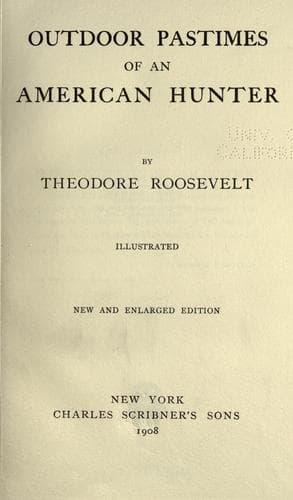
Outdoor pastimes of an American hunterRoosevelt, Theodore
General
Outdoor pastimes of an American hunter
Roosevelt, Theodore
Hunting -- United States; Hunting -- West (U.S.)
Fables aside, the cougar is a very interesting creature. It is found
from the cold, desolate plains of Patagonia to north of the Canadian
line, and lives alike among the snow-clad peaks of the Andes and in the
steaming forests of the Amazon. Doubtless careful investigation will
disclose several varying forms in an animal found over such immense
tracts of country and living under such utterly diverse conditions. But
in its essential habits and traits, the big, slinking, nearly
uni-colored cat seems to be much the same everywhere, whether living in
mountain, open plain, or forest, under arctic cold or tropic heat. When
the settlements become thick, it retires to dense forest, dark swamp or
inaccessible mountain gorge, and moves about only at night. In wilder
regions it not infrequently roams during the day and ventures freely
into the open. Deer are its customary prey where they are plentiful,
bucks, does, and fawns being killed indifferently. Usually the deer is
killed almost instantaneously, but occasionally there is quite a
scuffle, in which the cougar may get bruised, though, as far as I know,
never seriously. It is also a dreaded enemy of sheep, pigs, calves, and
especially colts, and when pressed by hunger a big male cougar will kill
a full-grown horse or cow, moose or wapiti. It is the special enemy of
mountain sheep. In 1886, while hunting white goats north of Clarke’s
fork of the Columbia, in a region where cougar were common, I found them
preying as freely on the goats as on the deer. It rarely catches
antelope, but is quick to seize rabbits, other small beasts, and even
porcupines, as well as bobcats, coyotes and foxes.
No animal, not even the wolf, is so rarely seen or so difficult to get
without dogs. On the other hand, no other wild beast of its size and
power is so easy to kill by the aid of dogs. There are many
contradictions in its character. Like the American wolf, it is certainly
very much afraid of man; yet it habitually follows the trail of the
hunter or solitary traveller, dogging his footsteps, itself always
unseen. I have had this happen to me personally. When hungry it will
seize and carry off any dog; yet it will sometimes go up a tree when
pursued even by a single small dog wholly unable to do it the least
harm. It is small wonder that the average frontier settler should grow
to regard almost with superstition the great furtive cat which he never
sees, but of whose presence he is ever aware, and of whose prowess
sinister proof is sometimes afforded by the deaths not alone of his
lesser stock, but even of his milch cow or saddle horse.
Public-domain text, read in full here on John Shaqi.
Reviews
Reviews
No reviews yet
Be the first to share your thoughts on this work.
Join the Discussion
Join the discussion
Sign in to leave a comment or review.
Sign InorCreate an account