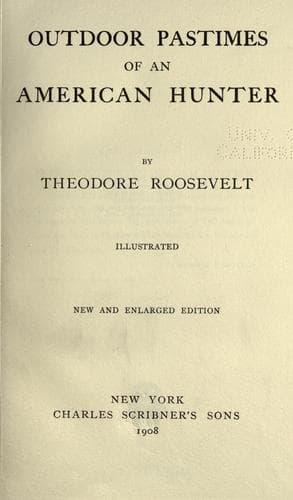
Outdoor pastimes of an American hunterRoosevelt, Theodore
General
Outdoor pastimes of an American hunter
Roosevelt, Theodore
Hunting -- United States; Hunting -- West (U.S.)
When I reached the post and dismounted at the Major’s house, I supposed
my experiences with wild beasts were ended for the day; but this was an
error. The quarters of the officers and men and the various hotel
buildings, stables, residences of the civilian officials, etc., almost
completely surround the big parade-ground at the post, near the middle
of which stands the flag-pole, while the gun used for morning and
evening salutes is well off to one side. There are large gaps between
some of the buildings, and Major Pitcher informed me that throughout the
winter he had been leaving alfalfa on the parade-grounds, and that
numbers of blacktail deer had been in the habit of visiting it every
day, sometimes as many as seventy being on the parade-ground at once. As
spring-time came on the numbers diminished. However, in mid-afternoon,
while I was writing in my room in Major Pitcher’s house, on looking out
of the window I saw five deer on the parade-ground. They were as tame as
so many Alderney cows, and when I walked out I got within twenty yards
of them without any difficulty. It was most amusing to see them as the
time approached for the sunset gun to be fired. The notes of the
trumpeter attracted their attention at once. They all looked at him
eagerly. One of them resumed feeding, and paid no attention whatever
either to the bugle, the gun or the flag. The other four, however,
watched the preparations for firing the gun with an intent gaze, and at
the sound of the report gave two or three jumps; then instantly
wheeling, looked up at the flag as it came down. This they seemed to
regard as something rather more suspicious than the gun, and they
remained very much on the alert until the ceremony was over. Once it was
finished, they resumed feeding as if nothing had happened. Before it was
dark they trotted away from the parade-ground back to the mountains.
The next day we rode off to the Yellowstone River, camping some miles
below Cottonwood Creek. It was a very pleasant camp. Major Pitcher, an
old friend, had a first-class pack-train, so that we were as comfortable
as possible, and on such a trip there could be no pleasanter or more
interesting companion than John Burroughs—“Oom John,” as we soon grew to
call him. Where our tents were pitched the bottom of the valley was
narrow, the mountains rising steep and cliff-broken on either side.
There were quite a number of blacktail in the valley, which were tame
and unsuspicious, although not nearly as much so as those in the
immediate neighborhood of the Mammoth Hot Springs. One mid-afternoon
three of them swam across the river a hundred yards above our camp. But
the characteristic animals of the region were the elk—the wapiti. They
were certainly more numerous than when I was last through the Park
twelve years before.
Public-domain text, read in full here on John Shaqi.
Reviews
Reviews
No reviews yet
Be the first to share your thoughts on this work.
Elsewhere in the archive
Join the Discussion
Join the discussion
Sign in to leave a comment or review.
Sign InorCreate an account