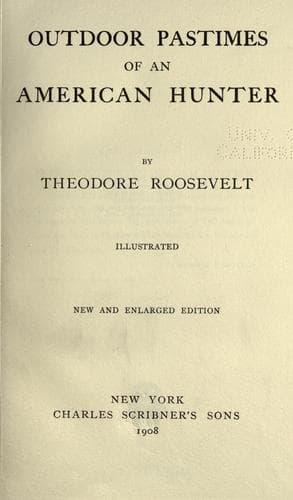
Outdoor pastimes of an American hunterRoosevelt, Theodore
General
Outdoor pastimes of an American hunter
Roosevelt, Theodore
Hunting -- United States; Hunting -- West (U.S.)
In the summer the elk spread all over the interior of the Park. As
winter approaches they divide, some going north and others south. The
southern bands, which, at a guess, may possibly include ten thousand
individuals, winter out of the Park, for the most part in Jackson’s
Hole—though of course here and there within the limits of the Park a few
elk may spend both winter and summer in an unusually favorable location.
It was the members of the northern band that I met. During the winter
time they are nearly stationary, each band staying within a very few
miles of the same place, and from their size and the open nature of
their habitat it is almost as easy to count them as if they were cattle.
From a spur of Bison Peak one day, Major Pitcher, the guide Elwood
Hofer, John Burroughs and I spent about four hours with the glasses
counting and estimating the different herds within sight. After most
careful work and cautious reduction of estimates in each case to the
minimum the truth would permit, we reckoned three thousand head of elk,
all lying or feeding and all in sight at the same time. An estimate of
some fifteen thousand for the number of elk in these Northern bands
cannot be far wrong. These bands do not go out of the Park at all, but
winter just within its northern boundary. At the time when we saw them,
the snow had vanished from the bottoms of the valleys and the lower
slopes of the mountains, but remained as continuous sheets farther up
their sides. The elk were for the most part found up on the snow slopes,
occasionally singly or in small gangs—more often in bands of from fifty
to a couple of hundred. The larger bulls were highest up the mountains
and generally in small troops by themselves, although occasionally one
or two would be found associating with a big herd of cows, yearlings,
and two-year-olds. Many of the bulls had shed their antlers; many had
not. During the winter the elk had evidently done much browsing, but at
this time they were grazing almost exclusively, and seemed by preference
to seek out the patches of old grass which were last left bare by the
retreating snow. The bands moved about very little, and if one were seen
one day it was generally possible to find it within a few hundred yards
of the same spot the next day, and certainly not more than a mile or two
off. There were severe frosts at night, and occasionally light flurries
of snow; but the hardy beasts evidently cared nothing for any but heavy
storms, and seemed to prefer to lie in the snow rather than upon the
open ground. They fed at irregular hours throughout the day, just like
cattle; one band might be lying down while another was feeding. While
travelling they usually went almost in single file. Evidently the winter
had weakened them, and they were not in condition for running; for on
the one or two occasions when I wanted to see them close up I ran right
into them on horseback, both on level plains and going up hill along the
Public-domain text, read in full here on John Shaqi.
Reviews
Reviews
No reviews yet
Be the first to share your thoughts on this work.
Elsewhere in the archive
Join the Discussion
Join the discussion
Sign in to leave a comment or review.
Sign InorCreate an account