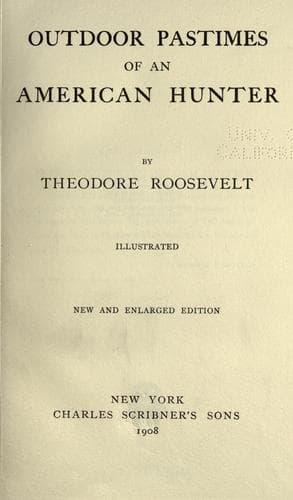
Outdoor pastimes of an American hunterRoosevelt, Theodore
General
Outdoor pastimes of an American hunter
Roosevelt, Theodore
Hunting -- United States; Hunting -- West (U.S.)
sides of rather steep mountains. One band in particular I practically
rounded up for John Burroughs, finally getting them to stand in a huddle
while he and I sat on our horses less than fifty yards off. After they
had run a little distance they opened their mouths wide and showed
evident signs of distress.
We came across a good many carcasses. Two, a bull and a cow, had died
from scab. Over half the remainder had evidently perished from cold or
starvation. The others, including a bull, three cows and a score of
yearlings, had been killed by cougars. In the Park the cougar is at
present their only animal foe. The cougars were preying on nothing but
elk in the Yellowstone Valley, and kept hanging about the neighborhood
of the big bands. Evidently they usually selected some outlying
yearling, stalked it as it lay or as it fed, and seized it by the head
and throat. The bull which they killed was in a little open valley by
himself, many miles from any other elk. The cougar which killed it,
judging from its tracks, was a big male. As the elk were evidently
rather too numerous for the feed, I do not think the cougars were doing
any damage.
Coyotes are plentiful, but the elk evidently have no dread of them. One
day I crawled up to within fifty yards of a band of elk lying down. A
coyote was walking about among them, and beyond an occasional look they
paid no heed to him. He did not venture to go within fifteen or twenty
paces of any one of them. In fact, except the cougar, I saw but one
living thing attempt to molest the elk. This was a golden eagle. We saw
several of these great birds. On one occasion we had ridden out to the
foot of a sloping mountain-side, dotted over with bands and strings of
elk amounting in the aggregate probably to a thousand head. Most of the
bands were above the snow-line—some appearing away back toward the ridge
crests, and looking as small as mice. There was one band well below the
snow-line, and toward this we rode. While the elk were not shy or wary,
in the sense that a hunter would use the words, they were by no means as
familiar as the deer; and this particular band of elk, some twenty or
thirty in all, watched us with interest as we approached. When we were
still half a mile off they suddenly started to run toward us, evidently
frightened by something. They ran quartering, and when about four
hundred yards away we saw that an eagle was after them. Soon it swooped,
and a yearling in the rear, weakly, and probably frightened by the
swoop, turned a complete somersault, and when it recovered its feet
stood still. The great bird followed the rest of the band across a
little ridge, beyond which they disappeared. Then it returned, soaring
high in the heavens, and after two or three wide circles, swooped down
at the solitary yearling, its legs hanging down. We halted at two
hundred yards to see the end. But the eagle could not quite make up its
mind to attack. Twice it hovered within a foot or two of the yearling’s
Public-domain text, read in full here on John Shaqi.
Reviews
Reviews
No reviews yet
Be the first to share your thoughts on this work.
Elsewhere in the archive
Join the Discussion
Join the discussion
Sign in to leave a comment or review.
Sign InorCreate an account