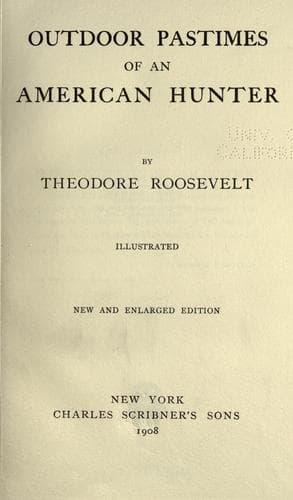
Outdoor pastimes of an American hunterRoosevelt, Theodore
General
Outdoor pastimes of an American hunter
Roosevelt, Theodore
Hunting -- United States; Hunting -- West (U.S.)
A couple of days after leaving Cottonwood Creek—where we had spent
several days—we camped at the Yellowstone Canyon below Tower Falls. Here
we saw a second band of mountain sheep, numbering only eight—none of
them old rams. We were camped on the west side of the canyon; the sheep
had their abode on the opposite side, where they had spent the winter.
It has recently been customary among some authorities, especially the
English hunters and naturalists who have written of the Asiatic sheep,
to speak as if sheep were naturally creatures of the plains rather than
mountain climbers. I know nothing of the Old World sheep, but the Rocky
Mountain bighorn is to the full as characteristic a mountain animal, in
every sense of the word, as the chamois, and, I think, as the ibex.
These sheep were well known to the road builders, who had spent the
winter in the locality. They told me they never went back on the plains,
but throughout the winter had spent their days and nights on the top of
the cliff and along its face. This cliff was an alternation of sheer
precipices and very steep inclines. When coated with ice it would be
difficult to imagine an uglier bit of climbing; but throughout the
winter, and even in the wildest storms, the sheep had habitually gone
down it to drink at the water below. When we first saw them they were
lying sunning themselves on the edge of the canyon, where the rolling
grassy country behind it broke off into the sheer descent. It was
mid-afternoon and they were under some pines. After a while they got up
and began to graze, and soon hopped unconcernedly down the side of the
cliff until they were half-way to the bottom. They then grazed along the
sides, and spent some time licking at a place where there was evidently
a mineral deposit. Before dark they all lay down again on a steeply
inclined jutting spur midway between the top and bottom of the canyon.
Next morning I thought I would like to see them close up, so I walked
down three or four miles below where the canyon ended, crossed the
stream, and came up the other side until I got on what was literally the
stamping-ground of the sheep. Their tracks showed that they had spent
their time for many weeks, and probably for all the winter, within a
very narrow radius. For perhaps a mile and a half, or two miles at the
very outside, they had wandered to and fro on the summit of the canyon,
making what was almost a well-beaten path; always very near and usually
on the edge of the cliff, and hardly ever going more than a few yards
back into the grassy plain-and-hill country. Their tracks and dung
covered the ground. They had also evidently descended into the depths of
the canyon wherever there was the slightest break or even lowering in
the upper line of the basalt cliffs. Although mountain sheep often
browse in winter, I saw but few traces of browsing here; probably on the
sheer cliff side they always get some grazing.
Public-domain text, read in full here on John Shaqi.
Reviews
Reviews
No reviews yet
Be the first to share your thoughts on this work.
Elsewhere in the archive
Join the Discussion
Join the discussion
Sign in to leave a comment or review.
Sign InorCreate an account