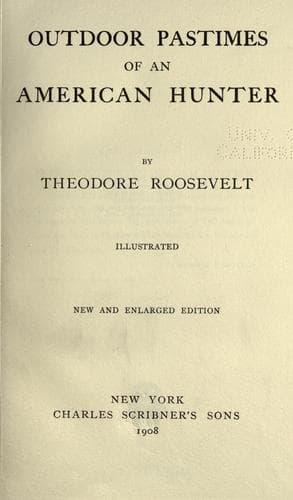
Outdoor pastimes of an American hunterRoosevelt, Theodore
General
Outdoor pastimes of an American hunter
Roosevelt, Theodore
Hunting -- United States; Hunting -- West (U.S.)
When I spied the band they were lying not far from the spot in which
they had lain the day before, and in the same position on the brink of
the canyon. They saw me and watched me with interest when I was two
hundred yards off, but they let me get up within forty yards and sit
down on a large stone to look at them, without running off. Most of them
were lying down, but a couple were feeding steadily throughout the time
I watched them. Suddenly one took the alarm and dashed straight over the
cliff, the others all following at once. I ran after them to the edge in
time to see the last yearling drop off the edge of the basalt cliff and
stop short on the sheer slope below, while the stones dislodged by his
hoofs rattled down the canyon. They all looked up at me with great
interest, and then strolled off to the edge of a jutting spur and lay
down almost directly underneath me and some fifty yards off. That
evening on my return to camp we watched the band make its way right down
to the river bed, going over places where it did not seem possible a
four-footed creature could pass. They halted to graze here and there,
and down the worst places they went very fast with great bounds. It was
a marvellous exhibition of climbing.
After we had finished this horseback trip we went on sleds and skis to
the upper Geyser Basin and the Falls of the Yellowstone. Although it was
the third week in April, the snow was still several feet deep, and only
thoroughly trained snow horses could have taken the sleighs along, while
around the Yellowstone Falls it was possible to move only on snowshoes.
There was little life in those woods. In the upper basin I caught a
meadow mouse on the snow; I afterwards sent it to Hart Merriam, who told
me it was of a species he had described from Idaho, _Microtus nanus_; it
had not been previously found in the Yellowstone region. We saw an
occasional pine squirrel, snowshoe rabbit or marten; and in the open
meadows around the hot waters there were Canada geese and ducks of
several species, and now and then a coyote. Around camp Clark’s crows
and Stellar’s jays, and occasionally magpies, came to pick at the
refuse; and of course they were accompanied by the whiskey jacks, which
behaved with their usual astounding familiarity. At Norris Geyser Basin
there was a perfect chorus of bird music from robins, western purple
finches, juncos and mountain bluebirds. In the woods there were mountain
chickadees and pygmy nuthatches, together with an occasional woodpecker.
In the northern country we had come across a very few blue grouse and
ruffed grouse, both as tame as possible. We had seen a pygmy owl no
larger than a robin sitting on the top of a pine in broad daylight, and
uttering at short intervals a queer un-owl-like cry.
[Illustration:
OOM JOHN
]
Public-domain text, read in full here on John Shaqi.
Reviews
Reviews
No reviews yet
Be the first to share your thoughts on this work.
Elsewhere in the archive
Join the Discussion
Join the discussion
Sign in to leave a comment or review.
Sign InorCreate an account