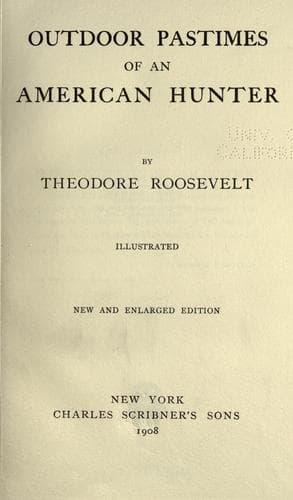
Outdoor pastimes of an American hunterRoosevelt, Theodore
General
Outdoor pastimes of an American hunter
Roosevelt, Theodore
Hunting -- United States; Hunting -- West (U.S.)
The birds that interested us most were the solitaires, and especially
the dippers or water-ousels. We were fortunate enough to hear the
solitaires sing not only when perched on trees, but on the wing, soaring
over a great canyon. They are striking birds in every way, and their
habit of singing while soaring, and their song, are alike noteworthy.
Once I heard a solitaire singing at the top of a canyon, and an ousel
also singing but a thousand feet below him; and in this case I thought
the ousel sang better than his unconscious rival. The ousels are to my
mind well-nigh the most attractive of all our birds, because of their
song, their extraordinary habits, their whole personality. They stay
through the winter in the Yellowstone because the waters are in many
places open. We heard them singing cheerfully, their ringing melody
having a certain suggestion of the winter wren’s. Usually they sang
while perched on some rock on the edge or in the middle of the stream;
but sometimes on the wing; and often just before dipping under the
torrent, or just after slipping out from it onto some ledge of rock or
ice. In the open places the Western meadow lark was uttering its
beautiful song; a real song as compared to the plaintive notes of its
Eastern brother, and though short, yet with continuity and tune as well
as melody. I love to hear the Eastern meadow lark in the early spring;
but I love still more the song of the Western meadow lark. No bird
escaped John Burroughs’ eye; no bird note escaped his ear.
I cannot understand why the Old World ousel should have received such
comparatively scant attention in the books, whether from nature writers
or poets; whereas our ousel has greatly impressed all who know him. John
Muir’s description comes nearest doing him justice. To me he seems a
more striking bird than for instance the skylark; though of course I not
only admire but am very fond of the skylark. There are various pipits
and larks in our own country which sing in highest air, as does the
skylark, and their songs, though not as loud, are almost as sustained;
and though they lack the finer kind of melody, so does his. The ousel,
on the contrary, is a really brilliant singer, and in his habits he is
even farther removed from the commonplace and the uninteresting than the
lark himself. Some birds, such as the ousel, the mocking-bird, the
solitaire, show marked originality, marked distinction; others do not;
the chipping sparrow, for instance, while in no way objectionable (like
the imported house sparrow), is yet a hopelessly commonplace little bird
alike in looks, habits and voice.
[Illustration:
BEARS AND TOURISTS
]
Public-domain text, read in full here on John Shaqi.
Reviews
Reviews
No reviews yet
Be the first to share your thoughts on this work.
Elsewhere in the archive
Join the Discussion
Join the discussion
Sign in to leave a comment or review.
Sign InorCreate an account