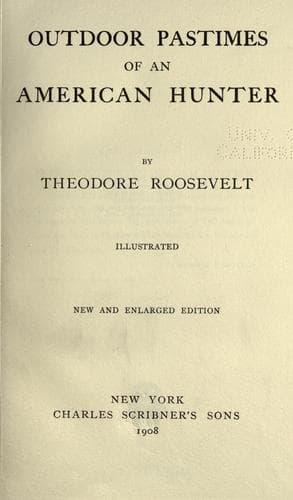
Outdoor pastimes of an American hunterRoosevelt, Theodore
General
Outdoor pastimes of an American hunter
Roosevelt, Theodore
Hunting -- United States; Hunting -- West (U.S.)
Among Long Island singers the wood thrushes are the sweetest; they nest
right around our house, and also in the more open woods of oak, hickory,
and chestnut, where their serene, leisurely songs ring through the leafy
arches all day long, but especially at daybreak and in the afternoons.
Baltimore orioles, beautiful of voice and plumage, hang their nests in a
young elm near a corner of the porch; robins, catbirds, valiant
kingbirds, song-sparrows, chippies, bright colored thistle-finches, nest
within a stone’s throw of the house, in the shrubbery or among the
birches and maples; grasshopper sparrows, humble little creatures with
insect-like voices, nest almost as close, in the open field, just beyond
the line where the grass is kept cut; humming-birds visit the
honeysuckles and trumpet-flowers; chimney swallows build in the
chimneys; barn swallows nest in the stable and old barn, wrens in the
bushes near by. Downy woodpeckers and many other birds make their homes
in the old orchard; during the migrations it is alive with warblers.
Towhees, thrashers, and Maryland yellow-throats build and sing in the
hedges by the garden; bush sparrows and dainty little prairie warblers
in the cedar-grown field beyond. Red-wing blackbirds haunt the wet
places. Chickadees wander everywhere; the wood-pewees, red-eyed vireos,
and black-and-white creepers keep to the tall timber, where the wary,
thievish jays chatter, and the great-crested fly-catchers flit and
scream. In the early spring, when the woods are still bare, when the
hen-hawks cry as they soar high in the upper air, and the flickers call
and drum on the dead trees, the strong, plaintive note of the meadow
lark is one of the most noticeable and most attractive sounds. On the
other hand, the cooing of the mourning doves is most noticeable in the
still, hot summer days. In the thick tangles chats creep and flutter and
jerk, and chuckle and whoop as they sing; I have heard them sing by
night. The cedar birds offer the most absolute contrast to the chats, in
voice, manner, and habits. They never hide, they are never fussy or
noisy; they always behave as if they were so well-bred that it is
impossible to resent the inroads the soft, quiet, pretty creatures make
among the cherries. One flicker became possessed of a mania to dig its
hole in one corner of the house, just under the roof. It hammered
lustily at boards and shingles, and returned whenever driven away; until
at last we were reluctantly forced to decree its death. Oven-birds are
very plentiful, and it seems to me that their flight song is more
frequently given after dusk than in daylight. It is sometimes given when
the whippoorwills are calling. In late June evenings, especially by
moonlight, but occasionally even when the night is dark, we hear this
song from the foot of the hill where the woods begin. There seems to be
one particular corner where year after year one or more oven-birds dwell
Public-domain text, read in full here on John Shaqi.
Reviews
Reviews
No reviews yet
Be the first to share your thoughts on this work.
Elsewhere in the archive
Join the Discussion
Join the discussion
Sign in to leave a comment or review.
Sign InorCreate an account