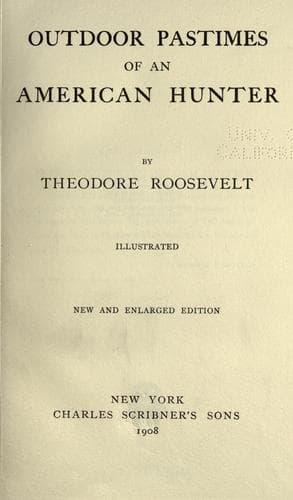
Outdoor pastimes of an American hunterRoosevelt, Theodore
General
Outdoor pastimes of an American hunter
Roosevelt, Theodore
Hunting -- United States; Hunting -- West (U.S.)
which possess an especial fondness for this night-singing in the air. It
is a pity the little eared owl is called screech-owl. Its tremulous,
quavering cry is not a screech at all, and has an attraction of its own.
These little owls come up to the house after dark, and are fond of
sitting on the elk antlers over the gable. When the moon is up, by
choosing one’s position, the little owl appears in sharp outline against
the bright disk, seated on his many-tined perch.
[Illustration:
ALGONQUIN AND SKIP
]
The neighborhood of Washington abounds in birds no less than in flowers.
There have been one or two rather curious changes among its birds since
John Burroughs wrote of them forty years ago. He speaks of the
red-headed woodpecker as being then one of the most abundant of all
birds—even more so than the robin. It is not uncommon now, and a pair
have for three years nested in the White House grounds; but it is at
present by no means an abundant bird. On the other hand, John Burroughs
never saw any mocking-birds, whereas during the last few years these
have been increasing in numbers, and there are now several places within
easy walking or riding distance where we are almost sure to find them.
The mocking-bird is as conspicuous as it is attractive, and when at its
best it is the sweetest singer of all birds; though its talent for
mimicry, and a certain odd perversity in its nature, often combine to
mar its performances. The way it flutters and dances in the air when
settling in a tree-top, its alert intelligence, its good looks, and the
comparative ease with which it can be made friendly and familiar, all
add to its charm. I am sorry to say that it does not nest in the White
House grounds. Neither does the wood thrush, which is so abundant in
Rock Creek Park, within the city limits. Numbers of robins,
song-sparrows, sputtering, creaking purple grackles—crow blackbirds—and
catbirds nest in the grounds. So, I regret to say, do crows, the sworn
foes of all small birds, and as such entitled to no mercy. The hearty,
wholesome, vigorous songs of the robins, and the sweet, homelike strains
of the song-sparrows are the first to be regularly heard in the grounds,
and they lead the chorus. The catbirds chime in later; they are queer,
familiar, strongly individual birds, and are really good singers; but
they persist in interrupting their songs with catlike squalling. Two or
three pairs of flickers nest with us, as well as the red-headed
woodpeckers above mentioned; and a pair of furtive cuckoos. A pair of
orchard orioles nested with us one spring, but not again; the redstarts,
warbling vireos, and summer warblers have been more faithful. Baltimore
orioles frequently visit us, as do the scarlet tanagers and tufted
titmice, but for some reason they have not nested here. This spring a
cardinal bird took up his abode in the neighborhood of the White House,
and now and then waked us in the morning by his vigorous whistling in a
Public-domain text, read in full here on John Shaqi.
Reviews
Reviews
No reviews yet
Be the first to share your thoughts on this work.
Elsewhere in the archive
Join the Discussion
Join the discussion
Sign in to leave a comment or review.
Sign InorCreate an account