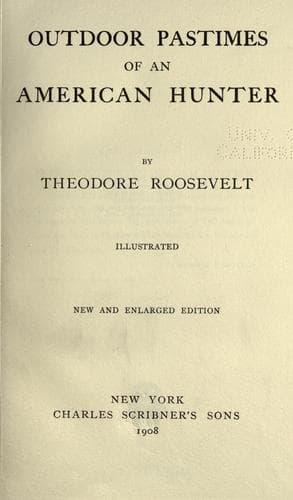
Outdoor pastimes of an American hunterRoosevelt, Theodore
General
Outdoor pastimes of an American hunter
Roosevelt, Theodore
Hunting -- United States; Hunting -- West (U.S.)
In October, 1907, I spent a fortnight in the canebrakes of northern
Louisiana, my hosts being Messrs. John M. Parker and John A. McIlhenny.
Surgeon-General Rixey, of the United States Navy, and Dr. Alexander
Lambert were with me. I was especially anxious to kill a bear in these
canebrakes after the fashion of the old Southern planters, who for a
century past have followed the bear with horse, hound and horn in
Louisiana, Mississippi and Arkansas.
Our first camp was on Tensas Bayou. This is in the heart of the great
alluvial bottom-land created during the countless ages through which the
mighty Mississippi has poured out of the heart of the continent. It is
in the black belt of the South, in which the negroes outnumber the
whites four or five to one, the disproportion in the region in which I
was actually hunting being far greater. There is no richer soil in all
the earth; and when, as will soon be the case, the chances of disaster
from flood are over, I believe the whole land will be cultivated and
densely peopled. At present the possibility of such flood is a terrible
deterrent to settlement, for when the Father of Waters breaks his
boundaries he turns the country for a breadth of eighty miles into one
broad river, the plantations throughout all this vast extent being from
five to twenty feet under water. Cotton is the staple industry, corn
also being grown, while there are a few rice fields and occasional small
patches of sugar cane. The plantations are for the most part of large
size and tilled by negro tenants for the white owners. Conditions are
still in some respects like those of the pioneer days. The magnificent
forest growth which covers the land is of little value because of the
difficulty in getting the trees to market, and the land is actually
worth more after the timber has been removed than before. In
consequence, the larger trees are often killed by girdling, where the
work of felling them would entail disproportionate cost and labor. At
dusk, with the sunset glimmering in the west, or in the brilliant
moonlight when the moon is full, the cotton fields have a strange
spectral look, with the dead trees raising aloft their naked branches.
The cotton fields themselves, when the bolls burst open, seem almost as
if whitened by snow; and the red and white flowers, interspersed among
the burst-open pods, make the whole field beautiful. The rambling
one-story houses, surrounded by outbuildings, have a picturesqueness all
their own; their very looks betoken the lavish, whole-hearted, generous
hospitality of the planters who dwell therein.
Public-domain text, read in full here on John Shaqi.
Reviews
Reviews
No reviews yet
Be the first to share your thoughts on this work.
Elsewhere in the archive
Join the Discussion
Join the discussion
Sign in to leave a comment or review.
Sign InorCreate an account