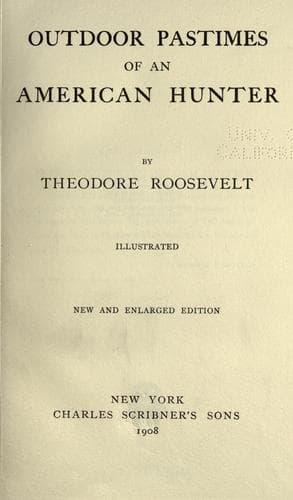
Outdoor pastimes of an American hunterRoosevelt, Theodore
General
Outdoor pastimes of an American hunter
Roosevelt, Theodore
Hunting -- United States; Hunting -- West (U.S.)
Beyond the end of cultivation towers the great forest. Wherever the
water stands in pools, and by the edges of the lakes and bayous, the
giant cypress looms aloft, rivalled in size by some of the red gums and
white oaks. In stature, in towering majesty, they are unsurpassed by any
trees of our eastern forests; lordlier kings of the green-leaved world
are not to be found until we reach the sequoias and redwoods of the
Sierras. Among them grow many other trees—hackberry, thorn, honey
locust, tupelo, pecan and ash. In the cypress sloughs the singular knees
of the trees stand two or three feet above the black ooze. Palmettos
grow thickly in places. The canebrakes stretch along the slight rises of
ground, often extending for miles, forming one of the most striking and
interesting features of the country. They choke out other growth, the
feathery, graceful canes standing tall, slender, serried, each but a few
inches from his brother, and springing to a height of fifteen or twenty
feet. They look like bamboos; they are well-nigh impenetrable for a man
on horseback; even on foot they make difficult walking unless free use
is made of the heavy bushknife. It is impossible to see through them for
more than fifteen or twenty paces, and often for not half that distance.
Bears make their lairs in them, and they are the refuge for hunted
things. Outside of them, in the swamp, bushes of many kinds grow thick
among the tall trees, and vines and creepers climb the trunks and hang
in trailing festoons from the branches. Here likewise the bushknife is
in constant play, as the skilled horsemen thread their way, often at a
gallop, in and out among the great tree trunks, and through the dense,
tangled, thorny undergrowth.
In the lakes and larger bayous we saw alligators and garfish; and
monstrous snapping turtles, fearsome brutes of the slime, as heavy as a
man, and with huge horny beaks that with a single snap could take off a
man’s hand or foot. One of the planters with us had lost part of his
hand by the bite of an alligator; and had seen a companion seized by the
foot by a huge garfish from which he was rescued with the utmost
difficulty by his fellow-swimmers. There were black bass in the waters
too, and they gave us many a good meal. Thick-bodied water moccasins,
foul and dangerous, kept near the water; and farther back in the swamp
we found and killed rattlesnakes and copperheads.
Coon and possum were very plentiful, and in the streams there were minks
and a few otters. Black squirrels barked in the tops of the tall trees
or descended to the ground to gather nuts or gnaw the shed deer
antlers—the latter a habit they shared with the wood rats. To me the
most interesting of the smaller mammals, however, were the swamp
rabbits, which are thoroughly amphibious in their habits, not only
swimming but diving, and taking to the water almost as freely as if they
were muskrats. They lived in the depths of the woods and beside the
lonely bayous.
Public-domain text, read in full here on John Shaqi.
Reviews
Reviews
No reviews yet
Be the first to share your thoughts on this work.
Elsewhere in the archive
Join the Discussion
Join the discussion
Sign in to leave a comment or review.
Sign InorCreate an account