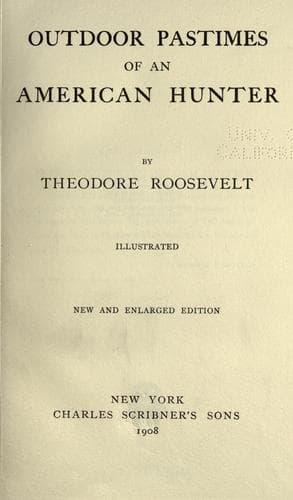
Outdoor pastimes of an American hunterRoosevelt, Theodore
General
Outdoor pastimes of an American hunter
Roosevelt, Theodore
Hunting -- United States; Hunting -- West (U.S.)
Birds were plentiful. Mocking-birds abounded in the clearings, where,
among many sparrows of more common kind, I saw the painted finch, the
gaudily colored brother of our little indigo bunting, though at this
season his plumage was faded and dim. In the thick woods where we hunted
there were many cardinal birds and Carolina wrens, both in full song.
Thrashers were even more common; but so cautious that it was rather
difficult to see them, in spite of their incessant clucking and calling
and their occasional bursts of song. There were crowds of warblers and
vireos of many different kinds, evidently migrants from the north, and
generally silent. The most characteristic birds, however, were the
woodpeckers, of which there were seven or eight species, the commonest
around our camp being the handsome red-bellied, the brother of the
red-head which we saw in the clearings. The most notable birds and those
which most interested me were the great ivory-billed woodpeckers. Of
these I saw three, all of them in groves of giant cypress; their
brilliant white bills contrasted finely with the black of their general
plumage. They were noisy but wary, and they seemed to me to set off the
wildness of the swamp as much as any of the beasts of the chase. Among
the birds of prey the commonest were the barred owls, which I have never
elsewhere seen so plentiful. Their hooting and yelling were heard all
around us throughout the night, and once one of them hooted at intervals
for several minutes at midday. One of these owls had caught and was
devouring a snake in the late afternoon, while it was still daylight. In
the dark nights and still mornings and evenings their cries seemed
strange and unearthly, the long hoots varied by screeches, and by all
kinds of uncanny noises.
At our first camp our tents were pitched by the bayou. For four days the
weather was hot, with steaming rains; after that it grew cool and clear.
Huge biting flies, bigger than bees, attacked our horses; but the insect
plagues, so veritable a scourge in this country during the months of
warm weather, had well-nigh vanished in the first few weeks of the fall.
Public-domain text, read in full here on John Shaqi.
Reviews
Reviews
No reviews yet
Be the first to share your thoughts on this work.
Elsewhere in the archive
Join the Discussion
Join the discussion
Sign in to leave a comment or review.
Sign InorCreate an account