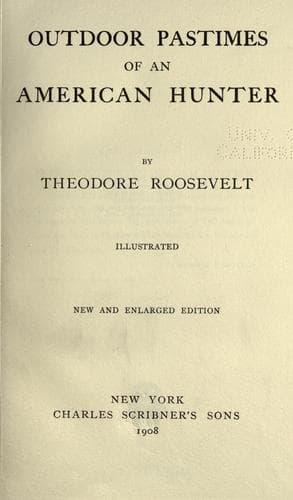
Outdoor pastimes of an American hunterRoosevelt, Theodore
General
Outdoor pastimes of an American hunter
Roosevelt, Theodore
Hunting -- United States; Hunting -- West (U.S.)
Hunting in the snow we were able to tell very clearly what the cougars
whose trails we were following had been doing. Goff’s eye for a trail
was unerring, and he read at a glance the lesson it taught. All the
cougars which we came across were living exclusively upon deer, and
their stomachs were filled with nothing else; much hair being mixed with
the meat. In each case the deer was caught by stalking and not by lying
in wait, and the cougar never went up a tree except to get rid of the
dogs. In the day-time it retired to a ledge, or ravine, or dense
thicket, starting to prowl as the dark came on. So far as I could see
the deer in each case was killed by a bite in the throat or neck. The
cougar simply rambled around in likely grounds until it saw or smelled
its quarry, and then crept up stealthily until with one or two
tremendous bounds it was able to seize its prey. If, as frequently
happened, the deer took alarm in time to avoid the first few bounds, it
always got away, for though the cougar is very fast for a short
distance, it has no wind whatever. It cannot pursue a deer for any
length of time, nor run before a dog for more than a few hundred yards,
if the dog is close up at the start. I was informed by the ranchmen that
when in May the deer leave the country, the cougars turn their attention
to the stock, and are very destructive. They have a special fondness for
horseflesh and kill almost every colt where they are plentiful, while
the big males work havoc with the saddle bands on the ranches, as well
as among the brood mares. Except in the case of a female with young they
are roving, wandering beasts, and roam great distances. After leaving
their day lairs, on a ledge, or in a gorge or thicket, they spend the
night travelling across the flats, along the ridges, over the spurs.
When they kill a deer they usually lie not very far away, and do not
again wander until they are hungry. The males travel very long distances
in the mating season. Their breeding-time is evidently irregular. We
found kittens with their eyes not yet open in the middle of January. Two
of the female cougars we killed were pregnant—in one case the young
would have been born almost immediately, that is, in February; and in
the other case in March. One, which had a partially grown young one of
over fifty pounds with it, still had milk in its teats. At the end of
January we found a male and female together, evidently mating. Goff has
also found the young just dropped in May, and even in June. The females
outnumber the males. Of the fourteen we killed, but three were males.
When a cougar kills a deer in the open it invariably drags it under some
tree or shelter before beginning to eat. All the carcasses we came
across had been thus dragged, the trail showing distinctly in the snow.
Goff, however, asserted that in occasional instances he had known a
cougar to carry a deer so that only its legs trailed on the ground.
Public-domain text, read in full here on John Shaqi.
Reviews
Reviews
No reviews yet
Be the first to share your thoughts on this work.
Join the Discussion
Join the discussion
Sign in to leave a comment or review.
Sign InorCreate an account