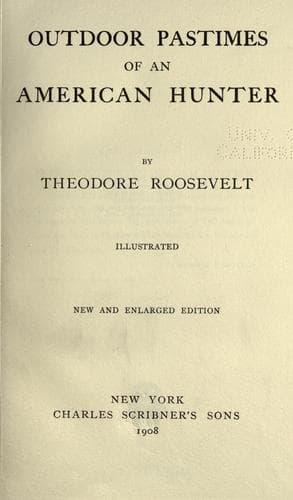
Outdoor pastimes of an American hunterRoosevelt, Theodore
General
Outdoor pastimes of an American hunter
Roosevelt, Theodore
Hunting -- United States; Hunting -- West (U.S.)
They had killed many deer and wildcat, and now and then a panther; but
their favorite game was the black bear, which, until within a very few
years, was extraordinarily plentiful in the swamps and canebrakes on
both sides of the lower Mississippi, and which is still found here and
there, although in greatly diminished numbers. In Louisiana and
Mississippi the bears go into their dens toward the end of January,
usually in hollow trees, often very high up in living trees, but often
also in great logs that lie rotting on the ground. They come forth
toward the end of April, the cubs having been born in the interval. At
this time the bears are nearly as fat, so my informants said, as when
they enter their dens in January; but they lose their fat very rapidly.
On first coming out in the spring they usually eat ash buds and the
tender young cane called mutton cane, and at that season they generally
refuse to eat the acorns even when they are plentiful. According to my
informants it is at this season that they are most apt to take to
killing stock, almost always the hogs which run wild or semi-wild in the
woods. They are very individual in their habits, however; many of them
never touch stock, while others, usually old he-bears, may kill numbers
of hogs; in one case an old he-bear began this hog-killing just as soon
as he left his den. In the summer months they find but little to eat,
and it is at this season that they are most industrious in hunting for
grubs, insects, frogs and small mammals. In some neighborhoods they do
not eat fish, while in other places, perhaps not far away, they not only
greedily eat dead fish, but will themselves kill fish if they can find
them in shallow pools left by the receding waters. As soon as the mast
is on the ground they begin to feed upon it, and when the acorns and
pecans are plentiful they eat nothing else; though at first berries of
all kinds and grapes are eaten also. When in November they have begun
only to eat the acorns they put on fat as no other wild animal does, and
by the end of December a full-grown bear may weigh at least twice as
much as it does in August, the difference being as great as between a
very fat and a lean hog. Old he-bears which in August weigh three
hundred pounds and upward will, toward the end of December, weigh six
hundred pounds, and even more in exceptional cases.
Public-domain text, read in full here on John Shaqi.
Reviews
Reviews
No reviews yet
Be the first to share your thoughts on this work.
Elsewhere in the archive
Join the Discussion
Join the discussion
Sign in to leave a comment or review.
Sign InorCreate an account