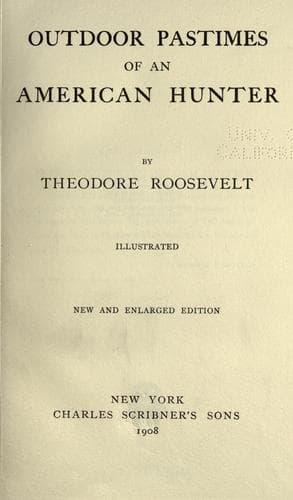
Outdoor pastimes of an American hunterRoosevelt, Theodore
General
Outdoor pastimes of an American hunter
Roosevelt, Theodore
Hunting -- United States; Hunting -- West (U.S.)
Bears vary greatly in their habits in different localities, in addition
to the individual variation among those of the same neighborhood. Around
Avery Island, John McIlhenny’s plantation, the bears only appear from
June to November; there they never kill hogs, but feed at first on corn
and then on sugar cane, doing immense damage in the fields, quite as
much as hogs would do. But when we were on the Tensas we visited a
family of settlers who lived right in the midst of the forest ten miles
from any neighbors; and although bears were plentiful around them they
never molested their corn fields—in which the coons, however, did great
damage.
A big bear is cunning, and is a dangerous fighter to the dogs. It is
only in exceptional cases, however, that these black bears, even when
wounded and at bay, are dangerous to men, in spite of their formidable
strength. Each of the hunters with whom I was camped had been charged by
one or two among the scores or hundreds of bears he had slain, but no
one of them had ever been injured, although they knew other men who had
been injured. Their immunity was due to their own skill and coolness;
for when the dogs were around the bear the hunter invariably ran close
in so as to kill the bear at once and save the pack. Each of the
Metcalfs had on one occasion killed a large bear with a knife, when the
hounds had seized it and the men dared not fire for fear of shooting one
of them. They had in their younger days hunted with a General Hamberlin,
a Mississippi planter whom they well knew, who was then already an old
man. He was passionately addicted to the chase of the bear, not only
because of the sport it afforded, but also in a certain way as a matter
of vengeance; for his father, also a keen bear-hunter, had been killed
by a bear. It was an old he, which he had wounded and which had been
bayed by the dogs; it attacked him, throwing him down and biting him so
severely that he died a couple of days later. This was in 1847. Mr. W.
H. Lambeth sends the following account of the fatal encounter:
“I send you an extract from the _Brother Jonathan_, published in New
York in 1847:
Public-domain text, read in full here on John Shaqi.
Reviews
Reviews
No reviews yet
Be the first to share your thoughts on this work.
Elsewhere in the archive
Join the Discussion
Join the discussion
Sign in to leave a comment or review.
Sign InorCreate an account