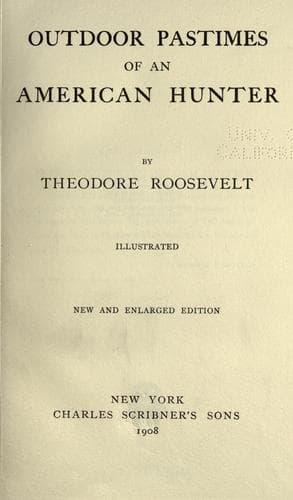
Outdoor pastimes of an American hunter — John Shaqi
Outdoor pastimes of an American hunterRoosevelt, Theodore
General
Outdoor pastimes of an American hunter
Roosevelt, Theodore
Hunting -- United States; Hunting -- West (U.S.)
I shot five bobcats: two old males weighing 39 and 31 pounds
respectively; and three females, weighing, respectively, 25, 21, and 18
pounds. Webb killed two, a male of 29 pounds and a female of 20; and
Stewart two females, one of 22 pounds, and the other a young one of 11
pounds.
I sent the cougar and bobcat skulls to Dr. Merriam, at the Biological
Survey, Department of Agriculture, Washington. He wrote me as follows:
“The big [cougar] skull is certainly a giant. I have compared it with
the largest in our collection from British Columbia and Wyoming, and
find it larger than either. It is in fact the largest skull of any
member of the _Felis concolor_ group I have seen. A hasty preliminary
examination indicates that the animal is quite different from the
northwest coast form, but that it is the same as my horse-killer from
Wyoming—_Felis hippolestes_. In typical _Felis concolor_ from Brazil the
skull is lighter, the brain-case thinner and more smoothly rounded,
devoid of the strongly developed sagittal crest; the under jaw
straighter and lighter.
“Your series of skulls from Colorado is incomparably the largest, most
complete and most valuable series ever brought together from any single
locality, and will be of inestimable value in determining the amount of
individual variation.”
[Illustration:
STARTING FOR A HUNT
From a photograph by Philip B. Stewart
]
We rode in to the Keystone Ranch late on the evening of the second day
after leaving Meeker. We had picked up a couple of bobcats on the way,
and had found a cougar’s kill (or bait, as Goff called it)—a doe, almost
completely eaten. The dogs puzzled for several hours over the cold trail
of the cougar; but it was old, and ran hither and thither over bare
ground, so that they finally lost it. The ranch was delightfully
situated at the foot of high wooded hills broken by cliffs, and it was
pleasant to reach the warm, comfortable log buildings, with their clean
rooms, and to revel in the abundant, smoking-hot dinner, after the long,
cold hours in the saddle. As everywhere else in the cattle country
nowadays, a successful effort had been made to store water on the
Keystone, and there were great stretches of wire fencing—two
improvements entirely unknown in former days. But the foreman, William
Wilson, and the two punchers or cowhands, Sabey and Collins, were of the
old familiar type—skilled, fearless, hardy, hard-working, with all the
intelligence and self-respect that we like to claim as typical of the
American character at its best. All three carried short saddle guns when
they went abroad, and killed a good many coyotes, and now and then a
gray wolf. The cattle were for the most part grade Herefords, very
different from the wild, slab-sided, long-horned creatures which covered
the cattle country a score of years ago.
Public-domain text, read in full here on John Shaqi.
Reviews
Reviews
No reviews yet
Be the first to share your thoughts on this work.
Join the Discussion
Join the discussion
Sign in to leave a comment or review.
Sign InorCreate an account