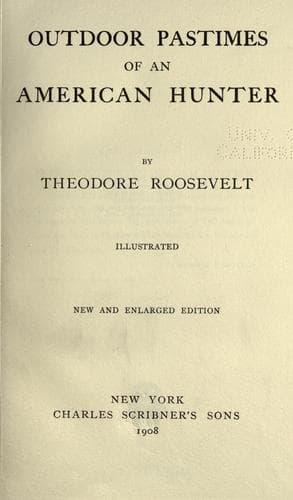
Outdoor pastimes of an American hunterRoosevelt, Theodore
General
Outdoor pastimes of an American hunter
Roosevelt, Theodore
Hunting -- United States; Hunting -- West (U.S.)
The black-throated green warblers have seemingly become regular summer
residents of Long Island, for after discovering them on my place I found
that two or three bird-loving neighbors were already familiar with them;
and I heard them on several different occasions as I rode through the
country roundabout. I already knew as summer residents in my
neighborhood the following representatives of the warbler family: the
oven-bird, chat, black-and-white creeper, Maryland yellow-throat, summer
yellow-bird, prairie warbler, pine warbler, blue-winged warbler,
golden-winged warbler (very rare), blue yellow-backed warbler and
redstart.
The black-throated green as a breeder and summer resident is a newcomer
who has extended his range southward. But this same summer I found one
warbler, the presence of which, if more than accidental, means that a
southern form is extending its range northward. This was the Dominican
or yellow-throated warbler. Two of my bird-loving neighbors are Mrs. E.
H. Swan, Jr., and Miss Alice Weekes. On July 4th Mrs. Swan told me that
a new warbler, the yellow-throated, was living near their house, and
that she and her husband had seen it there on several occasions. I was
rather skeptical, and told her I thought that it must be a Maryland
yellow-throat. Mrs. Swan meekly acquiesced in the theory that she might
have been mistaken; but two or three days afterward she sent me word
that she and Miss Weekes had seen the bird again, had examined it
thoroughly through their glasses, and were sure that it was a
yellow-throated warbler. Accordingly on the morning of the 8th I walked
down and met them both near Mrs. Swan’s house, about a mile from
Sagamore Hill. We did not have to wait long before we heard an
unmistakably new warbler’s song, loud, ringing, sharply accented, just
as the yellow-throat’s song is described in Chapman’s book. At first the
little bird kept high in the tops of the pines, but after a while he
came to the lower branches and we were able to see him distinctly. Only
a glance was needed to show that my two friends were quite right in
their identification and that the bird was undoubtedly the Dominican or
yellow-throated warbler. Its bill was as long as that of a
black-and-white creeper, giving the head a totally different look from
that of any of its brethren, the other true wood-warblers; and the
olive-gray back, yellow-throat and breast, streaked sides, white belly,
black cheek and forehead, and white line above the eye and spot on the
side of the neck, could all be plainly made out. The bird kept
continually uttering its loud, sharply modulated, and attractive warble.
It never left the pines, and though continually on the move, it yet
moved with a certain deliberation like a pine warbler, and not with the
fussy agility of most of its kinsfolk. Occasionally it would catch some
insect on the wing, but most of the time kept hopping about among the
needle-clad clusters of the pine twigs, or moving along the larger
Public-domain text, read in full here on John Shaqi.
Reviews
Reviews
No reviews yet
Be the first to share your thoughts on this work.
Elsewhere in the archive
Join the Discussion
Join the discussion
Sign in to leave a comment or review.
Sign InorCreate an account