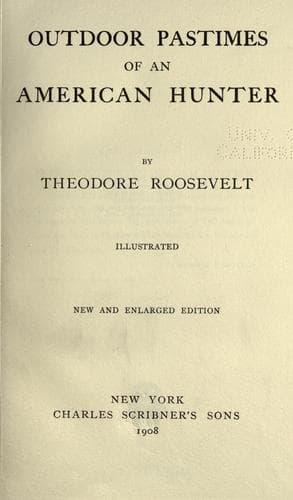
Outdoor pastimes of an American hunterRoosevelt, Theodore
General
Outdoor pastimes of an American hunter
Roosevelt, Theodore
Hunting -- United States; Hunting -- West (U.S.)
branches, stopping from time to time to sing. Now and then it would sit
still on one twig for several minutes, singing at short intervals and
preening its feathers.
[Illustration:
THE STONE WALL
From a photograph by Mrs. Herbert Wadsworth
]
After looking at it for nearly an hour we had to solve the rather
difficult ethical question as to whether we ought to kill it or not. In
these cases it is always hard to draw the line between heartlessness and
sentimentality. In our own minds we were sure of our identification, and
did not feel that we could be mistaken, but we were none of us professed
ornithologists, and as far as I knew the bird was really rare thus far
north; so that it seemed best to shoot him, which was accordingly done.
I was influenced in this decision, in the first place because warblers
are so small that it is difficult for any observer to be absolutely
certain as to their identification; and in the next place by the fact
that the breeding season was undoubtedly over, and that this was an
adult male, so that no harm came to the species. I very strongly feel
that there should be no “collecting” of rare and beautiful species when
this is not imperatively demanded. Mocking-birds, for instance, are very
beautiful birds, well known and unmistakable; and there is not the
slightest excuse for “collecting” their nests and eggs or shooting
specimens of them, no matter where they may be found. So, there is no
excuse for shooting scarlet tanagers, summer redbirds, cardinals, nor of
course any of the common, well-known friends of the lawn, the garden and
the farm land; and with most birds nowadays observations on their habits
are of far more value than their skins can possibly be. But there must
be some shooting, especially of obscure and little-known birds, or we
would never be able to identify them at all; while most laymen are not
sufficiently close observers to render it possible to trust their
identification of rare species.
Public-domain text, read in full here on John Shaqi.
Reviews
Reviews
No reviews yet
Be the first to share your thoughts on this work.
Elsewhere in the archive
Join the Discussion
Join the discussion
Sign in to leave a comment or review.
Sign InorCreate an account