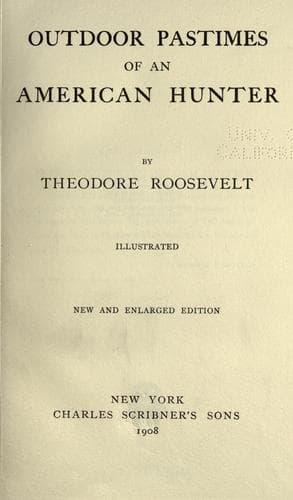
Outdoor pastimes of an American hunterRoosevelt, Theodore
General
Outdoor pastimes of an American hunter
Roosevelt, Theodore
Hunting -- United States; Hunting -- West (U.S.)
In one apple tree in the orchard we find a flicker’s nest every year;
the young make a queer, hissing, bubbling sound, a little like the
boiling of a pot. This same year one of the young ones fell out; I
popped it back into the hole, whereupon its brothers and sisters
“boiled” for several minutes like the cauldron of a small and friendly
witch. John Burroughs, and a Long Island neighbor, John Lewis Childs,
drove over to see me, in this same June of 1907, and I was able to show
them the various birds of most interest—the purple finch, the
black-throated green warbler, the redwings in their unexpected nesting
place by the old barn, and the orchard orioles and yellow-billed cuckoos
in the garden. The orchard orioles this year took much interest in the
haying, gleaning in the cut grass for grasshoppers. The barn swallows
that nest in the stable raised second broods, which did not leave the
nest until the end of July. When the barn swallows gather in their great
flocks just prior to the southward migration, the gathering sometimes
takes place beside a house, and then the swallows seem to get so excited
and bewildered that they often fly into the house. When I was a small
boy I took a keen, although not a very intelligent, interest in natural
history, and solemnly recorded whatever I thought to be notable. When I
was nine years old we were passing the summer near Tarrytown, on the
Hudson. My diary for September 4, 1868, runs as follows: “Cold and
rainy. I was called in from breakfast to a room. When I went in there
what was my surprise to see on walls, curtains and floor about forty
swallows. All the morning long in every room of the house (even the
kitchen) were swallows. They were flying south. Several hundred were
outside and about seventy-five in the house. I caught most of them (and
put them out of the windows). The others got out themselves. One flew on
my pants where he stayed until I took him off.”
At the White House we are apt to stroll around the grounds for a few
minutes after breakfast; and during the migrations, especially in
spring, I often take a pair of field glasses so as to examine any bird
as to the identity of which I am doubtful. From the end of April the
warblers pass in troops—myrtle, magnolia, chestnut-sided, bay-breasted,
blackburnian, black-throated blue, blue-winged, Canadian, and many
others, with at the very end of the season the black-poll—all of them
exquisite little birds, but not conspicuous as a rule, except perhaps
the blackburnian, whose brilliant orange throat and breast flame when
they catch the sunlight as he flits among the trees. The males in their
dress of courtship are easily recognized by any one who has Chapman’s
book on the warblers. On May 4, 1906, I saw a Cape May warbler, the
first I had ever seen. It was in a small pine. It was fearless, allowing
a close approach, and as it was a male in high plumage, it was
unmistakable.
Public-domain text, read in full here on John Shaqi.
Reviews
Reviews
No reviews yet
Be the first to share your thoughts on this work.
Elsewhere in the archive
Join the Discussion
Join the discussion
Sign in to leave a comment or review.
Sign InorCreate an account