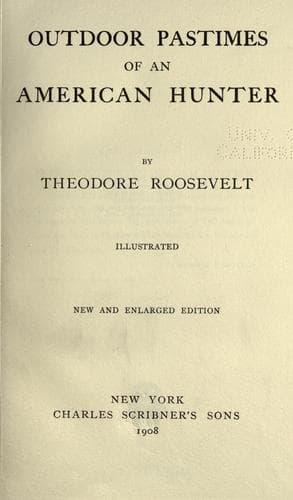
Outdoor pastimes of an American hunterRoosevelt, Theodore
General
Outdoor pastimes of an American hunter
Roosevelt, Theodore
Hunting -- United States; Hunting -- West (U.S.)
The birds are, of course, for the most part the same as on Long Island,
but with some differences. These differences are, in part, due to the
more southern locality; but in part I cannot explain them, for birds
will often be absent from one place seemingly without any real reason.
Thus around us in Albemarle County song-sparrows are certainly rare and
I have not seen savanna sparrows at all; but the other common sparrows,
such as the chippy, field sparrow, vesper sparrow, and grasshopper
sparrow abound; and in an open field where bind-weed morning glories and
evening primroses grew among the broom sedge, I found some small
grass-dwelling sparrows, which with the exercise of some little patience
I was able to study at close quarters with the glasses; as I had no gun
I could not be positive about their identification, though I was
inclined to believe that they were Henslow’s sparrows. Of birds of
brilliant color there are six species—the cardinal, the summer redbird
and the scarlet tanager, in red, and the bluebird, indigo bunting, and
blue grossbeak, in blue. I saw but one pair of blue grossbeaks; but the
little indigo buntings abound, and bluebirds are exceedingly common,
breeding in numbers. It has always been a puzzle to me why they do not
breed around us at Sagamore Hill, where I only see them during the
migrations. Neither the rosy summer redbirds nor the cardinals are quite
as brilliant as the scarlet tanagers, which fairly burn like live
flames; but the tanager is much less common than either of the others in
Albemarle County, and it is much less common than it is at Sagamore
Hill. Among the singers the wood thrush is not common, but the meadow
lark abounds. The yellow-breasted chat is everywhere and in the spring
its clucking, whistling and calling seem never to stop for a minute. The
white-eyed vireo is found in the same thick undergrowth as the chat and
among the smaller birds it is one of those most in evidence to the ear.
In one or two places I came across parties of the long-tailed Bewick’s
wren, as familiar as the house wren but with a very different song.
There are gentle mourning doves; and black-billed cuckoos seem more
common than the yellow-bills. The mocking-birds are, as always, most
interesting. I was much amused to see one of them following two crows;
when they lit in a plowed field the mocking-bird paraded alongside of
them six feet off, and then fluttered around to the attack. The crows,
however, were evidently less bothered by it than they would have been by
a kingbird. At Plain Dealing many birds nest within a stone’s throw of
the rambling attractive house, with its numerous outbuildings, old
garden, orchard, and venerable locusts and catalpas. Among them are
Baltimore and orchard orioles, purple grackles, flickers and red-headed
woodpeckers, bluebirds, robins, kingbirds and indigo buntings. One
observation which I made was of real interest. On May 18, 1907, I saw a
Public-domain text, read in full here on John Shaqi.
Reviews
Reviews
No reviews yet
Be the first to share your thoughts on this work.
Elsewhere in the archive
Join the Discussion
Join the discussion
Sign in to leave a comment or review.
Sign InorCreate an account