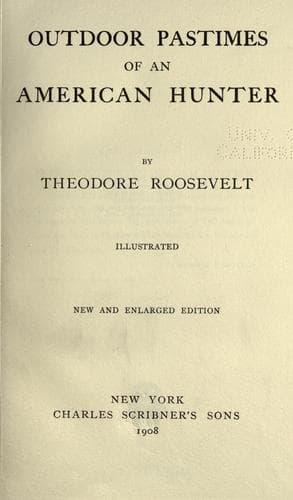
Outdoor pastimes of an American hunterRoosevelt, Theodore
General
Outdoor pastimes of an American hunter
Roosevelt, Theodore
Hunting -- United States; Hunting -- West (U.S.)
small party of a dozen or so of passenger pigeons, birds I had not seen
for a quarter of a century and never expected to see again. I saw them
two or three times flying hither and thither with great rapidity, and
once they perched in a tall dead pine on the edge of an old field. They
were unmistakable; yet the sight was so unexpected that I almost doubted
my eyes, and I welcomed a bit of corroborative evidence coming from
Dick, the colored foreman at Plain Dealing. Dick is a frequent companion
of mine in rambles around the country, and he is an unusually close and
accurate observer of birds, and of wild things generally. Dick had
mentioned to me having seen some “wild carrier pigeons,” as he called
them; and, thinking over this remark of his, after I had returned to
Washington, I began to wonder whether he too might not have seen
passenger pigeons. Accordingly I wrote to Mr. Wilmer, asking him to
question Dick and find out what the “carrier pigeons” looked like. His
answering letter runs in part as follows:
“On May 12th last Dick saw a flock of about thirty wild pigeons,
followed at a short distance by about half as many, flying in a
circle very rapidly, between the Plain Dealing house and the
woods, where they disappeared. They had pointed tails and
resembled somewhat large doves—the breast and sides rather a
brownish red. He had seen them before, but many years ago. I think
it is unquestionably the passenger pigeon—_Ectopistes
migratorius_—described on p. 25 of the 5th volume of Audubon. I
remember the pigeon roosts as he describes them, on a smaller
scale, but large flocks have not been seen in this part of
Virginia for many years.”
I fear, by the way, that the true prairie chicken, one of the most
characteristic American game birds, will soon follow the passenger
pigeon. My two elder sons have now and then made trips for prairie
chickens and ducks to the Dakotas. Last summer, 1907, the second boy
returned from such a trip—which he had ended by a successful deer hunt
in Wisconsin—with the melancholy information that the diminution in the
ranks of the prairie fowl in the Dakotas was very evident.
Public-domain text, read in full here on John Shaqi.
Reviews
Reviews
No reviews yet
Be the first to share your thoughts on this work.
Elsewhere in the archive
Join the Discussion
Join the discussion
Sign in to leave a comment or review.
Sign InorCreate an account