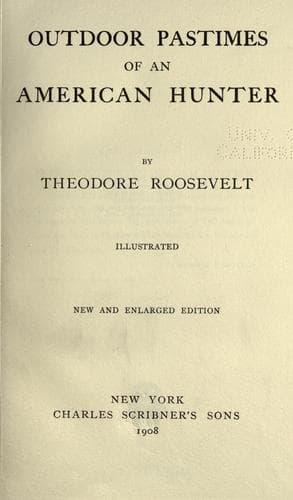
Outdoor pastimes of an American hunterRoosevelt, Theodore
General
Outdoor pastimes of an American hunter
Roosevelt, Theodore
Hunting -- United States; Hunting -- West (U.S.)
In a few minutes the coyote was skinned, the dogs rested, and we were
jogging on once more. Hour after hour passed by. We had a couple more
runs, but in each case the coyote had altogether too long a start and
got away; the dogs no longer being as fresh as they had been. As a rule,
although there are exceptions, if the greyhounds cannot catch the coyote
within two or three miles the chances favor the escape of the little
wolf. We found that if the wolf had more than half a mile start he got
away. As greyhounds hunt by sight, cut banks enable the coyote easily to
throw off his pursuers unless they are fairly close up. The greyhounds
see the wolf when he is far off, for they have good eyes; but in the
chase, if the going is irregular, they tend to lose him, and they do not
depend much on one another in recovering sight of him; on the contrary,
the dog is apt to quit when he no longer has the quarry in view.
[Illustration:
AT THE TAIL OF THE CHUCK WAGON
From a photograph by W. Sloan Simpson
]
At noon we joined the chuck wagon where it stood drawn up on a slope of
the treeless, bushless prairie; and the active round-up cook soon had
the meal ready. It was the Four Sixes wagon, the brand burned into the
wood of the chuck box. Where does a man take more frank enjoyment in his
dinner than at the tail end of a chuck wagon?
Soon after eating we started again, having changed horses and dogs. I
was mounted on a Big D cow-pony, while Lambert had a dun-colored horse,
hard to hold, but very tough and swift. An hour or so after leaving camp
we had a four-mile run after a coyote, which finally got away, for it
had so long a start that the dogs were done out by the time they came
within fair distance. They stopped at a little prairie pool, some of
them lying or standing in it, panting violently; and thus we found them
as we came stringing up at a gallop. After they had been well rested we
started toward camp; but we were down in the creek bottom before we saw
another coyote. This one again was a long distance ahead, and I did not
suppose there was much chance of our catching him; but away all the dogs
and all the riders went at the usual run, and catch him we did, because,
as it turned out, the “morning” dogs, which were with the wagon, had
spied him first and run him hard, until he was in sight of the
“afternoon” dogs, which were with us. I got tangled in a washout,
scrambled out, and was galloping along, watching the country in front,
when Lambert passed me as hard as he could go; I saw him disappear into
another washout, and then come out on the other side, while the dogs
were driving the coyote at an angle down toward the creek. Pulling short
to the right, I got through the creek, hoping the coyote would cross,
and the result was that I galloped up to the worry almost as soon as the
foremost riders from the other side—a piece of good fortune for which I
had only luck to thank. The hounds caught the coyote as he was about
crossing the creek.
Public-domain text, read in full here on John Shaqi.
Reviews
Reviews
No reviews yet
Be the first to share your thoughts on this work.
Elsewhere in the archive
Join the Discussion
Join the discussion
Sign in to leave a comment or review.
Sign InorCreate an account