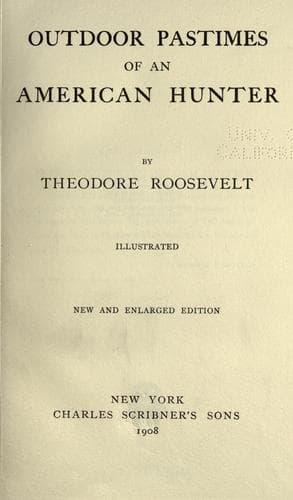
Outdoor pastimes of an American hunterRoosevelt, Theodore
General
Outdoor pastimes of an American hunter
Roosevelt, Theodore
Hunting -- United States; Hunting -- West (U.S.)
From this point it was but a short distance into
camp.
Again next morning we were off before the sun had risen high enough to
take away the cool freshness from the air. This day we travelled several
miles before we saw our first coyote. It was on a huge, gently sloping
stretch of prairie, which ran down to the creek on our right. We were
travelling across it strung out in line when the coyote sprang up a good
distance ahead of the dogs. They ran straight away from us at first.
Then I saw the coyote swinging to the right toward the creek and I
half-wheeled, riding diagonally to the line of the chase. This gave me
an excellent view of dogs and wolf, and also enabled me to keep nearly
abreast of them. On this particular morning the dogs were Bevin’s
greyhounds and staghounds. From where the dogs started they ran about
three miles, catching their quarry in the flat where the creek circled
around in a bend, and when it was not fifty yards from the timber. By
this time the puncher, Bony Moore, had passed me, most of the other
riders having been so far to the left when the run began that they were
unable to catch up. The little wolf ran well, and the greyhounds had
about reached their limit when they caught up with it. But they lasted
just long enough to do the work. A fawn-colored greyhound and a black
staghound were the first dogs up. The staghound tried to seize the
coyote, which dodged a little to one side; the fawn-colored greyhound
struck and threw it; and in another moment the other dogs were up and
the worry began. I was able to see the run so well, because Tom Burnett
had mounted me on his fine roan cutting horse. We sat around in a
semicircle on the grass until the dogs had been breathed, and then
started off again. After some time we struck another coyote, but rather
far off, and this time the dogs were not fresh. After running two or
three miles he pulled away and we lost him, the dogs refreshing
themselves by standing and lying in a shallow prairie pool.
In the afternoon we again rode off, and this time Abernethy, on his
white horse, took the lead, his greyhounds trotting beside him. There
was a good deal of rivalry among the various owners of the hounds as to
which could do best, and a slight inclination among the cowboys to be
jealous of Abernethy. No better riders could be imagined than these same
cowboys, and their greyhounds were stanch and fast; but Abernethy, on
his tough white horse, not only rode with great judgment, but showed a
perfect knowledge of the coyote, and by his own exertions greatly
assisted his hounds. He had found out in his long experience that while
the greyhounds could outpace a coyote in a two or three mile run, they
would then fall behind; but that after going eight or ten miles, a
coyote in turn became exhausted, and if he had been able to keep his
hounds going until that time, they could, with his assistance, then stop
the quarry.
[Illustration:
THE BIG D. COW-PONY
Public-domain text, read in full here on John Shaqi.
Reviews
Reviews
No reviews yet
Be the first to share your thoughts on this work.
Elsewhere in the archive
Join the Discussion
Join the discussion
Sign in to leave a comment or review.
Sign InorCreate an account