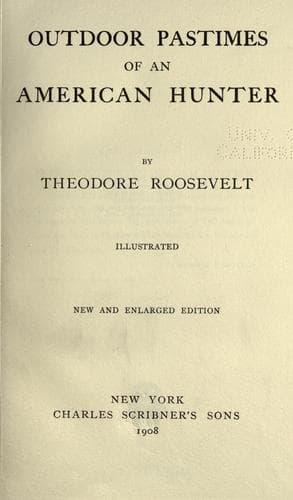
Outdoor pastimes of an American hunterRoosevelt, Theodore
General
Outdoor pastimes of an American hunter
Roosevelt, Theodore
Hunting -- United States; Hunting -- West (U.S.)
In the early nineties the ravages of the wolves along the Little
Missouri became so serious as thoroughly to arouse the stockmen. Not
only colts and calves, and young trail stock, but in midwinter
full-grown horses and steers were continually slain. The county
authorities put a bounty of three dollars each on wolf scalps, to which
the ranchmen of the neighborhood added a further bounty of five dollars.
This made eight dollars for every wolf, and as the skin was also worth
something, the business of killing wolves became profitable. Quite a
number of men tried poisoning or trapping, but the most successful wolf
hunter on the Little Missouri at that time was a man who did not rely on
poison at all, but on dogs. He was named Massingale, and he always had a
pack of at least twenty hounds. The number varied, for a wolf at bay is
a terrible fighter, with jaws like those of a steel trap, and teeth that
cut like knives, so that the dogs were continually disabled and
sometimes killed, and the hunter had always to be on the watch to add
animals to his pack. It was not a good-looking pack, but it was
thoroughly fit for its own work. Most of the dogs were greyhounds,
whether rough or smooth haired, but many of them were big mongrels, part
greyhound and part some other breed, such as bulldog, mastiff,
Newfoundland, bloodhound, or collie. The only two requisites were that
the dogs should run fast and fight gamely; and in consequence they
formed as wicked, hard-biting a crew as ever ran down and throttled a
wolf. They were usually taken out ten at a time, and by their aid
Massingale killed over two hundred wolves, including cubs. Of course
there was no pretence of giving the game fair play. The wolves were
killed as vermin, not for sport. The greatest havoc was in the
spring-time, when the she-wolves were followed to their dens. Some of
the hounds were very fast, and they could usually overtake a young or
weak wolf; but an old dog wolf, with a good start, unless run into at
once, would ordinarily get away if he were in running trim. Frequently,
however, he was caught when not in running trim, for the hunter was apt
to find him when he had killed a calf or taken part in dragging down a
horse or steer, and was gorged with meat. Under these circumstances he
could not run long before the pack. If possible, as with all such packs,
the hunter himself got up in time to end the worry by a stab of his
hunting-knife; but unless he was quick he had nothing to do, for the
pack was thoroughly competent to do its own killing. Grim fighter though
a great dog wolf is, he stands no show before the onslaught of ten such
hounds, agile and powerful, who rush on their antagonist in a body.
Massingale’s dogs possessed great power in their jaws, and unless he was
up within two or three minutes after the wolf was overtaken, they tore
him to death, though one or more of their number might be killed or
crippled in the fight. The wolf might be throttled without having the
Public-domain text, read in full here on John Shaqi.
Reviews
Reviews
No reviews yet
Be the first to share your thoughts on this work.
Elsewhere in the archive
Join the Discussion
Join the discussion
Sign in to leave a comment or review.
Sign InorCreate an account