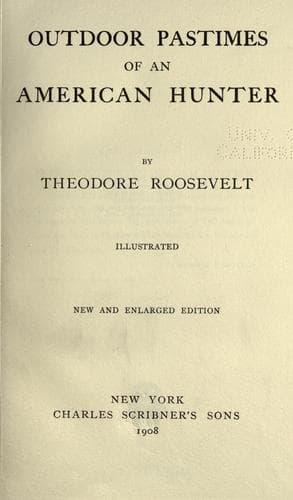
Outdoor pastimes of an American hunterRoosevelt, Theodore
General
Outdoor pastimes of an American hunter
Roosevelt, Theodore
Hunting -- United States; Hunting -- West (U.S.)
hide on its neck torn; but when it was stretched out the dogs ripped
open its belly. Dogs do not get their teeth through the skin of an old
cougar; but they will tear up either a bobcat or coyote.
In 1894 and 1896 I saw a number of wolves on the Little Missouri,
although I was not looking for them. I frequently came upon the remains
of sheep and young stock which they had killed; and once, upon the top
of a small plateau, I found the body of a large steer, while the torn
and trodden ground showed that he had fought hard for his life before
succumbing. There had been two wolves engaged in the work, and the
cunning beasts had evidently acted in concert. Apparently, while one
attracted the steer’s attention in front, the other, according to the
invariable wolf habit, attacked him from behind, hamstringing him and
tearing out his flanks. His body was still warm when I came up, but the
marauders had slunk off, either seeing or smelling me. There was no
mistaking the criminals, however, for, unlike bears, which usually
attack an animal at the withers, or cougars, which attack the throat or
head, wolves almost invariably attack their victim at the hind quarters
and begin first on the hams or flanks, if the animal is of any size.
Owing to their often acting in couples or in packs, the big wolves do
more damage to horned stock than cougars, but they are not as dangerous
to colts, and they are not nearly as expert as the big cats in catching
deer and mountain sheep. When food is plentiful, good observers say that
they will not try to molest foxes; but, if hungry, they certainly snap
them up as quickly as they would fawns. Ordinarily they show complete
tolerance of the coyotes; yet one bitter winter I knew of a coyote being
killed and eaten by a wolf.
Not only do the habits of wild beasts change under changing conditions
as time goes on, but there seems to be some change even in their
appearance. Thus the early observers of the game of the Little Missouri,
those who wrote in the first half of the nineteenth century, spoke much
of the white wolves which were then so common in the region. These white
wolves represented in all probability only a color variety of the
ordinary gray wolf; and it is difficult to say exactly why they
disappeared. Yet when about the year 1890 wolves again grew common these
white wolves were very, very rare; indeed I never personally heard of
but one being seen. This was on the Upper Cannonball in 1892. A nearly
black wolf was killed not far from this spot in the year 1893. At the
present day black wolves are more common than white wolves, which are
rare indeed. But all these big wolves are now decreasing in numbers, and
in most places are decreasing rapidly.
Public-domain text, read in full here on John Shaqi.
Reviews
Reviews
No reviews yet
Be the first to share your thoughts on this work.
Elsewhere in the archive
Join the Discussion
Join the discussion
Sign in to leave a comment or review.
Sign InorCreate an account