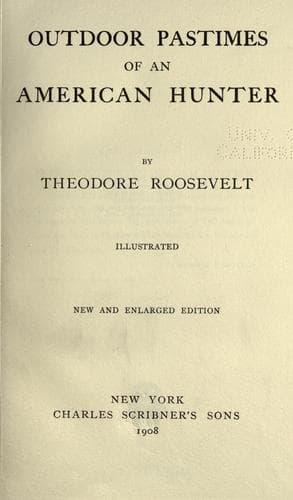
Outdoor pastimes of an American hunterRoosevelt, Theodore
General
Outdoor pastimes of an American hunter
Roosevelt, Theodore
Hunting -- United States; Hunting -- West (U.S.)
In the old days the prongbuck was found as soon as the westward-moving
traveller left the green bottom-lands of the Mississippi, and from
thence across to the dry, open valleys of California, and northward to
Canada and southward into Mexico. It has everywhere been gradually
thinned out, and has vanished altogether from what were formerly the
extreme easterly and westerly limits of its range. The rates of
extermination of the different kinds of big game have been very unequal
in different localities. Each kind of big game has had its own peculiar
habitat in which it throve best, and each has also been found more or
less plentifully in other regions where the circumstances were less
favorable; and in these comparatively unfavorable regions it early tends
to disappear before the advance of man. In consequence, where the ranges
of the different game animals overlap and are intertwined, one will
disappear first in one locality, and another will disappear first where
the conditions are different. Thus the whitetail deer had thrust forward
along the very narrow river bottoms into the domain of the mule-deer and
the prongbuck among the foothills of the Rocky Mountains, and in these
places it was exterminated from the narrow strips which it inhabited
long before the mule-deer vanished from the high hills, or the prongbuck
from the great open plains. But along great portions of the Missouri
there are plenty of whitetails yet left in the river bottoms, while the
mule-deer that once dwelt in the broken hills behind them, and the
prongbuck which lived on the prairie just back of these bluffs, have
both disappeared. In the same way the mule-deer and the prongbuck are
often found almost intermingled through large regions in which plains,
hills, and mountains alternate. If such a region is mainly mountainous,
but contains a few valleys and table-lands, the prongbuck is sure to
vanish from the latter before the mule-deer vanishes from the broken
country. But if the region is one primarily of plains, with here and
there rows of rocky hills in which the mule-deer is found, the latter is
killed off long before the prongbuck can be hunted out of the great open
stretches. The same is true of the pronghorn and the wapiti. The size
and value of the wapiti make it an object of eager persecution on the
part of hunters. But as it can live in the forest-clad fastnesses of the
Rockies, into which settlement does not go, it outlasts over great
regions the pronghorn, whose abode is easily penetrated by sheep and
cattle men. Under anything like even conditions, however, the prongbuck,
of course, outlasts the wapiti. This was the case on the Little
Missouri. On that stream the bighorn also outlasted the wapiti. In 1881
wapiti were still much more plentiful than bighorns. Within the next
decade they had almost totally disappeared, while the bighorn was still
to be found; I shot one and saw others in 1893, at which time I had not
Public-domain text, read in full here on John Shaqi.
Reviews
Reviews
No reviews yet
Be the first to share your thoughts on this work.
Elsewhere in the archive
Join the Discussion
Join the discussion
Sign in to leave a comment or review.
Sign InorCreate an account