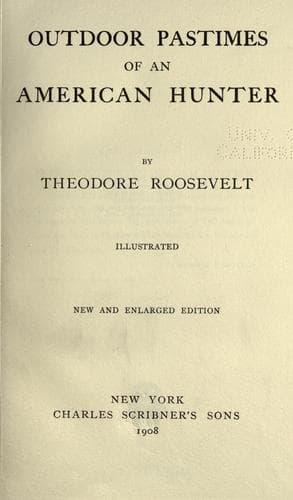
Outdoor pastimes of an American hunterRoosevelt, Theodore
General
Outdoor pastimes of an American hunter
Roosevelt, Theodore
Hunting -- United States; Hunting -- West (U.S.)
authentic information of a single wapiti remaining anywhere on the river
in my neighborhood, although it is possible that one or two still lurked
in some out-of-the-way recess. In Colorado at one time the bighorn was
nearly exterminated, while the wapiti still withstood the havoc made
among its huge herds; then followed a period in which the rapidity of
destruction of the wapiti increased far beyond that of the bighorn.
I mention these facts partly because they are of interest in themselves,
but chiefly because they tend to explain the widely different opinions
expressed by competent observers about what superficially seem to be
similar facts. It cannot be too often repeated that allowance must be
made for the individual variability in the traits and characters of
animals of the same species, and especially of the same species under
different circumstances and in different localities; and allowance must
also be made for the variability of the individual factor in the
observers themselves. Many seemingly contradictory observations of the
habits of deer, wapiti, and prongbuck will be found in books by the best
hunters. Take such questions as the keenness of sight of the deer as
compared with the prongbuck, and of the pugnacity of the wapiti, both
actual and relative, and a wide difference of opinion will be found in
three such standard works as Dodge’s “The Hunting-grounds of the Great
West,” Caton’s “Deer and Antelope of America,” and the contributions of
Mr. Grinnell to the “Century Book of Sports.” Sometimes the difference
will be in mere matters of opinion, as, for instance, in the belief as
to the relative worth of the sport furnished by the chase of the
different creatures; but sometimes there is a direct conflict of fact.
Colonel Dodge, for instance, has put it upon record that the wapiti is
an exceedingly gentle animal, less dangerous than a whitetail or
blacktail buck in a close encounter, and that the bulls hardly ever
fight among themselves. My own experience leads me to traverse in the
most emphatic manner every one of these conclusions, and all hunters
whom I have met feel exactly as I do; yet no one would question for a
moment Colonel Dodge’s general competency as an observer. In the same
way Mr. Grinnell has a high opinion of the deer’s keenness of sight.
Judge Caton absolutely disagrees with him, and my own experience tends
to agree with that of the Judge—at least to the extent of placing the
deer’s vision far below that of the prongbuck and even that of the
bighorn, and only on a par with that of the wapiti. Yet Mr. Grinnell is
an unusually competent observer, whose opinion on any such subject is
entitled to unqualified respect.
Public-domain text, read in full here on John Shaqi.
Reviews
Reviews
No reviews yet
Be the first to share your thoughts on this work.
Elsewhere in the archive
Join the Discussion
Join the discussion
Sign in to leave a comment or review.
Sign InorCreate an account