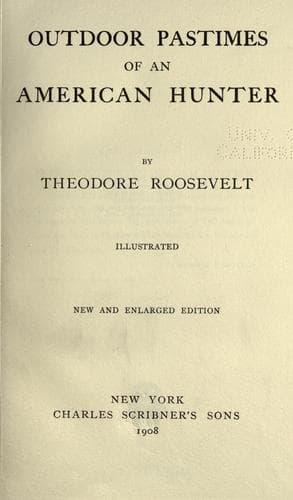
Outdoor pastimes of an American hunterRoosevelt, Theodore
General
Outdoor pastimes of an American hunter
Roosevelt, Theodore
Hunting -- United States; Hunting -- West (U.S.)
hand, if the skin-hunters discovered such a wintering place, they were
able to butcher practically the entire band, if they so desired, as the
prongbucks were always most reluctant to leave such a chosen ground.
Normally the prongbuck avoids both broken ground and timber. It is a
queer animal, with keen senses, but with streaks of utter folly in its
character. Time and again I have known bands rush right by me, when I
happened to surprise them feeding near timber or hills, and got between
them and the open plains. The animals could have escaped without the
least difficulty if they had been willing to go into the broken country,
or through even a few rods of trees and brush; and yet they preferred to
rush madly by me at close range, in order to get out to their favorite
haunts. But nowadays there are certain localities where the prongbucks
spend a large part of their time in the timber or in rough, hilly
country, feeding and bringing up their young in such localities.
Typically, however, the prongbuck is preeminently a beast of the great
open plains, eating their harsh, dry pasturage, and trusting to its own
keen senses and speed for its safety. All the deer are fond of skulking;
the whitetail preeminently so. The prongbuck, on the contrary, never
endeavors to elude observation. Its sole aim is to be able to see its
enemies, and it cares nothing whatever about its enemies seeing it. Its
coloring is very conspicuous, and is rendered still more so by its habit
of erecting the white hair on its rump. It has a very erect carriage,
and when it thinks itself in danger it always endeavors to get on some
crest or low hill from which it can look all about. The big bulging
eyes, situated at the base of the horns, scan the horizon far and near
like twin telescopes. They pick out an object at such a distance that it
would entirely escape the notice of a deer. When suspicious, they have a
habit of barking, uttering a sound something like “kau,” and repeating
it again and again, as they walk up and down, endeavoring to find out if
danger lurks in the unusual object. They are extremely curious, and in
the old days it was often possible to lure them toward the hunter by
waving a red handkerchief to and fro on a stick, or even by lying on
one’s back and kicking the legs. Nowadays, however, there are very few
localities indeed in which they are sufficiently unsophisticated to make
it worth while trying these time-honored tricks of the long-vanished
trappers and hunters.
Public-domain text, read in full here on John Shaqi.
Reviews
Reviews
No reviews yet
Be the first to share your thoughts on this work.
Elsewhere in the archive
Join the Discussion
Join the discussion
Sign in to leave a comment or review.
Sign InorCreate an account