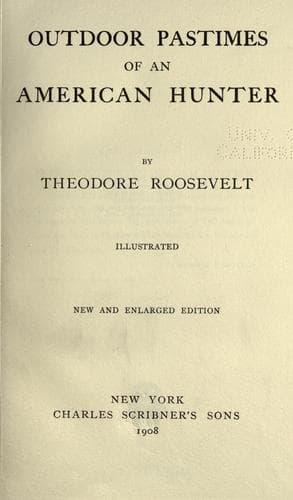
Outdoor pastimes of an American hunterRoosevelt, Theodore
General
Outdoor pastimes of an American hunter
Roosevelt, Theodore
Hunting -- United States; Hunting -- West (U.S.)
Difference in habits may be due simply to difference of locality, or to
the need of adaptation to new conditions. The prongbuck’s habits about
migration offer examples of the former kind of difference. Over portions
of its range the prongbuck is not migratory at all. In other parts the
migrations are purely local. In yet other regions the migrations are
continued for great distances, immense multitudes of the animals going
to and fro in the spring and fall along well-beaten tracks. I know of
one place in New Mexico where the pronghorn herds are tenants of certain
great plains throughout the entire year. I know another region in
northwestern Colorado where the very few prongbucks still left, though
they shift from valley to valley, yet spend the whole year in the same
stretch of rolling, barren country. On the Little Missouri, however,
during the eighties and early nineties, there was a very distinct though
usually local migration. Before the Black Hills had been settled they
were famous wintering places for the antelope, which swarmed from great
distances to them when cold weather approached; those which had summered
east of the Big Missouri actually swam the river in great herds, on
their journey to the Hills. The old hunters around my ranch insisted
that formerly the prongbuck had for the most part travelled from the
Little Missouri Bad Lands into the Black Hills for the winter.
[Illustration:
ON THE LITTLE MISSOURI
]
When I was ranching on that river, however, this custom no longer
obtained, for the Black Hills were too well settled, and the herds of
prongbuck that wintered there were steadily diminishing in numbers. At
that time, from 1883 to 1896, the seasonal change in habits, and shift
of position, of the prongbucks were well marked. As soon as the new
grass sprang they appeared in great numbers upon the plains. They were
especially fond of the green, tender blades that came up where the
country had been burned over. If the region had been devastated by
prairie fires in the fall, the next spring it was certain to contain
hundreds and thousands of prongbucks. All through the summer they
remained out on these great open plains, coming to drink at the little
pools in the creek beds, and living where there was no shelter of any
kind. As winter approached they began to gather in bands. Some of these
bands apparently had regular wintering places to the south of us, in
Pretty Buttes and beyond; and close to my ranch, at the crossing of the
creek called Beaver, there were certain trails which these antelope
regularly travelled, northward in the spring and southward in the fall.
But other bands would seek out places in the Bad Lands near by,
gathering together on some succession of plateaus which were protected
by neighboring hills from the deep drifts of snow. Here they passed the
winter, on short commons, it is true (they graze, not browsing like
deer), but without danger of perishing in the snowdrifts. On the other
Public-domain text, read in full here on John Shaqi.
Reviews
Reviews
No reviews yet
Be the first to share your thoughts on this work.
Elsewhere in the archive
Join the Discussion
Join the discussion
Sign in to leave a comment or review.
Sign InorCreate an account