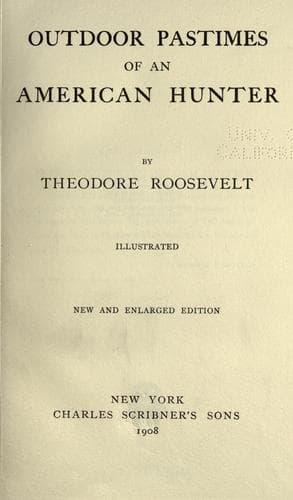
Outdoor pastimes of an American hunterRoosevelt, Theodore
General
Outdoor pastimes of an American hunter
Roosevelt, Theodore
Hunting -- United States; Hunting -- West (U.S.)
contained anything edible, and they would come close up and watch the
men plying the pick with the utmost interest. Mr. Hornaday took us
inside, and they all came up in the most friendly manner. One or two of
the bucks would put their heads against our legs and try to push us
around, but not roughly. Mr. Hornaday told me that he was having great
difficulty, exactly as with the mule-deer, in acclimatizing the
antelope, especially as the food was so different from what they were
accustomed to in their native haunts.
The wild fawns are able to run well a few days after they are born. They
then accompany the mother everywhere. Sometimes she joins a band of
others; more often she stays alone with her fawn, and perhaps one of the
young of the previous year, until the rut begins. Of all game the
prongbuck seems to me the most excitable during the rut. The males run
the does much as do the bucks of the mule and whitetail deer. If there
are no does present, I have sometimes watched a buck run to and fro by
himself. The first time I saw this I was greatly interested, and could
form no idea of what the buck was doing. He was by a creek bed in a
slight depression or shallow valley, and was grazing uneasily. After a
little while he suddenly started and ran just as hard as he could, off
in a straight direction, nearly away from me. I thought that somehow or
other he had discovered my presence; but he suddenly wheeled and came
back to the original place, still running at his utmost speed. Then he
halted, moved about with the white hairs on his rump outspread, and
again dashed off at full speed, halted, wheeled, and came back. Two or
three times he did this, and let me get very close to him before he
discovered me. I was too much interested in what he was doing to desire
to shoot him.
In September, sometimes not earlier than October, the big bucks begin to
gather the does into harems. Each buck is then constantly on the watch
to protect his harem from outsiders, and steal another doe if he can get
a chance. I have seen a comparatively young buck who had appropriated a
doe, hustle her hastily out of the country as soon as he saw another
antelope in the neighborhood; while, on the other hand, a big buck,
already with a good herd of does, will do his best to appropriate any
other that comes in sight. The bucks fight fearlessly but harmlessly
among themselves, locking their horns and then pushing as hard as they
can.
Public-domain text, read in full here on John Shaqi.
Reviews
Reviews
No reviews yet
Be the first to share your thoughts on this work.
Elsewhere in the archive
Join the Discussion
Join the discussion
Sign in to leave a comment or review.
Sign InorCreate an account