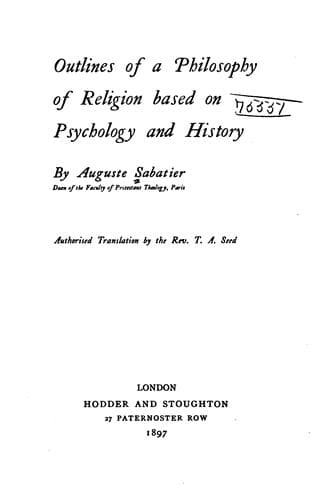
We need not go beyond the Positivists themselves for examples and
proofs of this persistence of the religious sentiment. Comte, Spencer,
and Littre may be called as witnesses. The founder of Positivism, who
had predicted the fatal extinction of the disposition to religion in
the human soul, crowned his system and ended his career by founding a
new religion, clumsily copied from the sacerdotal organisation and the
ritual practices of Roman Catholicism. There actually exists a
Positivist Church, with a calendar of saints, with relics and
anniversaries, with a catechism, and with a high priest not less
infallible than the one at Rome. A few disciples, scandalised by this
supreme temptation of the master, desired to excuse him by declaring
that he had gone mad. It was a mistake. The fact is that, arriving at
the construction of a Positive Sociology, Comte comprehended the _role_
of the religious instinct and of religious feeling in the life of
peoples, and he believed that he would only be able to cement the
edifice of society in the future by religion. It is said that those
who have been amputated sometimes feel sharp twitches in the limbs they
have lost. Comte and his disciples have experienced something similar.
Nature, with her usual irony, has avenged herself on them for the
violence they have done to her.
Of Herbert Spencer not much need be said; everybody knows that the
_Unknowable_ in his system has become a sort of undetermined and
unconscious force, eluding every effort of the mind to grasp it, but
remaining, none the less, the cause explaining evolution, and the
source profound whence all things flow. Under different names, do we
not recognise the First Cause of the philosophers, and the image,
half-effaced, of the God of believers? Need we be surprised that the
English thinker pronounces religion to be eternal? that he finally
reduces the mental life of man to these two essential and primordial
activities--the scientific activity which pursues the knowledge of
phenomena and their transformation, and religious activity delivering
itself up to mystical contemplation and to silent adoration of
universal being?
Public-domain text, read in full here on John Shaqi.
Reviews
Reviews
No reviews yet
Be the first to share your thoughts on this work.
Join the Discussion
Join the discussion
Sign in to leave a comment or review.
Sign InorCreate an account