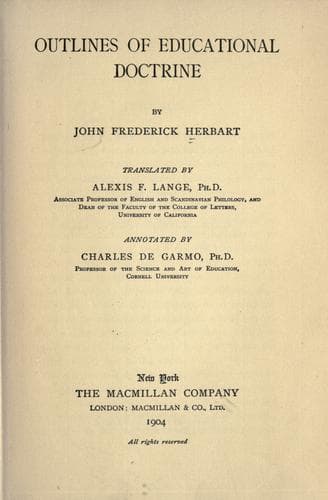
Outlines of Educational DoctrineHerbart, Johann Friedrich
Philosophy
Outlines of Educational Doctrine
Herbart, Johann Friedrich
Education -- Philosophy
188. Fifth. The pupil’s mind, we will suppose, has been properly
directed, partly through the social relations obtaining among children,
partly through examples and instruction, to the requirements of the
various moral ideas, and he has learned accordingly to discriminate
with some keenness between will relations. Now the time has arrived for
moral education in the strict sense. For we cannot leave it to chance
whether our young charges will, of their own initiative, synthesize
for themselves noble actions on the one hand and base actions on the
other, whether they will take time to reflect, and will, each for
himself, apply the lessons taught. On the contrary, they all have to
be told, each one individually has to be told, truths that no one is
wont to hear with pleasure. The more thoroughly the teacher knows his
pupils, the better. By showing them that he divines their thoughts, he
supplies them with the most effectual incentive to self-observation.
Now the basis of what is commonly known as moralizing is furnished
by a retrospective view of the pupil’s conduct for some time past,
by references to influences formerly at work within him, and by an
analysis of his good and bad qualities. Such teaching is by no means
to be condemned, nor even to be regarded as superfluous. In its proper
place it is absolutely essential. Many, it is true, grow up without
ever having heard a serious word of deserved censure, but no one ought
to grow up in that way.
189. Only praise and censure are thought of here, not harsh words, much
less harsh treatment. Reprimands and punishments following upon single
acts are something different; they, too, may lead to moral reflections,
but must first have become things of the past. Moral improvement is not
brought about by the constraint of government, nor is it the result
of those pedagogical punishments which warn the pupil and sharpen his
wits by means of the natural consequences of actions (157). But it is
brought about through the imitation of the language of conscience and
of genuine honor, as seen in impartial spectators. Moreover, this
does not exclude consideration of the excuses which every one readily
finds in his heart. But while due allowance is made for mitigating
circumstances, the pupil is cautioned against relying on them in future.
Public-domain text, read in full here on John Shaqi.
Reviews
Reviews
No reviews yet
Be the first to share your thoughts on this work.
Elsewhere in the archive
Join the Discussion
Join the discussion
Sign in to leave a comment or review.
Sign InorCreate an account