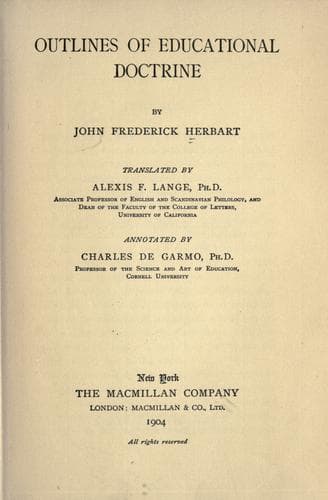
Outlines of Educational DoctrineHerbart, Johann Friedrich
Philosophy
Outlines of Educational Doctrine
Herbart, Johann Friedrich
Education -- Philosophy
190. Ordinarily youth deserves neither strong commendation nor severe
criticism, and it is well to guard carefully against exaggeration
in either direction, if for no other reason than merely this, that
exaggeration either detracts from effectiveness, or else causes,
if not timidity, at least an unfortunate embarrassment. There is
one species of magnifying, however, which subserves a good purpose,
because it enables pupils to see more clearly the importance of
trifles and the great significance of their own actions, and in this
way helps to counteract thoughtlessness. We refer to viewing the
present in the light of the future. The pettiest faults are liable to
grow through habit; the faintest desire, unless kept under control,
may turn into passion. Then, too, the future circumstances of one’s
life are uncertain; allurements and temptations may come into it, or
unlooked-for misfortunes. This prevision of the possibilities of the
future is, of course, not prophecy, and no such claim should be made
for it; nevertheless, it does good service as a warning.
191. When the pupil has been brought to the point where he regards
his moral education as a matter of serious import, instruction in
conjunction with a growing knowledge of the world may bring it about
that a glow of moral sentiment permeates his whole thought, and that
the idea of a moral order unites on the one hand with his religious
concepts, and with his self-observation on the other. Henceforth the
direct, emphatic expression of praise or censure will have to be less
frequent. It will no longer be as easy as formerly to give a clearer
account to the pupil of what goes on within him than he has already
rendered to himself. We may still, however, come to his assistance from
another direction, namely, that of general concepts,--a field in which
advancing youthful reflection is little by little finding its bearings.
192. Sixth. It is the business of training to remind at the right
moment and to correct faults. We may safely assume that, even after a
young man has reached the plane of moral decisions, he will still stand
in need of frequent reminders, although in this respect individuals
exhibit great differences, which observation alone is able to reveal.
But that which he is reminded of consists of resolves which lay claim
to something like universal validity, but which are not likely to make
good that claim when incorrectly formulated or conceived in the wrong
connection. General considerations become predominant with only a very
few at best; but youth especially sees and experiences so much that
is new that the old is easily slighted for the new, and, accordingly,
the general for the particular still more. Nevertheless, it is far
easier for training to remind and to correct with success where a good,
firm foundation has been laid, than it is to support (161–166) when in
adolescence nothing is found by which the pupil might try to steady
himself.
Public-domain text, read in full here on John Shaqi.
Reviews
Reviews
No reviews yet
Be the first to share your thoughts on this work.
Elsewhere in the archive
Join the Discussion
Join the discussion
Sign in to leave a comment or review.
Sign InorCreate an account