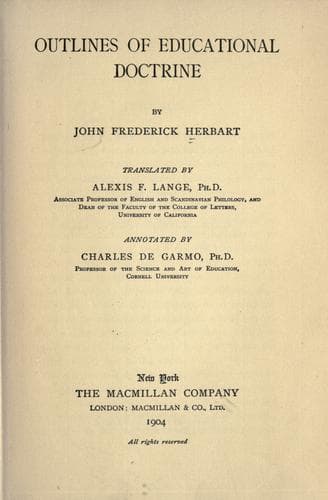
Outlines of Educational DoctrineHerbart, Johann Friedrich
Philosophy
Outlines of Educational Doctrine
Herbart, Johann Friedrich
Education -- Philosophy
In general, all helps whereby historical objects may be represented to
sense--portraits, pictures of buildings, of ruins, etc.--are desirable;
maps for the more ancient times must be regarded as particularly
indispensable. They should always be at hand, and their study
should not be neglected. Among these helps must be included charts,
substantially like that by Strass entitled “The Stream of Time,” which
places before the eye not only synchronistic events, but at the same
time shows also the alternate union and division of countries. The lack
of such aids causes the loss of much time and temper over mere memory
work.
Again, attention is due to the following four aspects of the teaching
of history:--
245. (1) In the first place, even the earliest lessons in geography
give rise to the question, whenever the description of a country is
finished, “How did things look in this country formerly?” For it is
a part of correct apprehension that cities and other works of man
should not be regarded as of equal age with mountains, rivers, and
oceans. Now, although the teacher cannot stop, during the time set
apart for geography dealing with the present, to show and explain maps
illustrative of the past, it will be useful, nevertheless, to add a
few remarks about the early history of the country under discussion.
The art of narration, however, is out of place here, inasmuch as the
question, although reaching back in time, is suggested by the country.
Mention of former activity, such as migrations and wars, is made simply
for the purpose of adding life to the conception of a stationary
surface. At the beginning, the notes on by-gone periods in connection
with the geography of Germany will accordingly be as brief as possible;
gradually, however, as France, England, Spain, Italy, are being studied
in succession, these historical notes become knit together, and history
is thus, so to speak, made to loom up in the distance. How far to go
in this direction can be determined more definitely by distinguishing
between the requirements of the first, and of the second course in
geography. In the first course the most general statements may suffice,
_e.g._, that not so very long ago Germany was split up more than now;
that there were older times, when cities and neighboring princes often
made war upon each other; that the barons used to live on more or less
inaccessible heights; but that, in the interest of better order and
stricter surveillance, Germany was divided into ten districts, etc.
The second course will admit of more historical facts than the first,
although still only very few pertaining to an older epoch. Only the
more recent events can be conveniently connected with geography, except
in the case of still extant historical monuments,--such, for instance,
as the ruins in Italy, the composite language of England, the peculiar
political organization of Switzerland with its many subdivisions,
visible on the map, and its diversities of language.
Public-domain text, read in full here on John Shaqi.
Reviews
Reviews
No reviews yet
Be the first to share your thoughts on this work.
Elsewhere in the archive
Join the Discussion
Join the discussion
Sign in to leave a comment or review.
Sign InorCreate an account