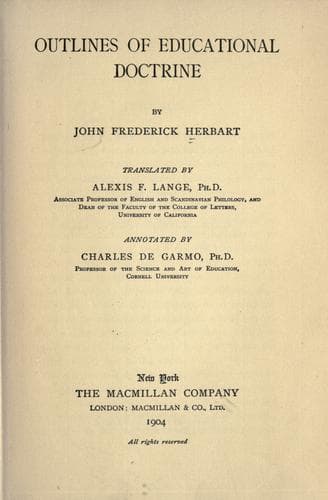
Outlines of Educational DoctrineHerbart, Johann Friedrich
Philosophy
Outlines of Educational Doctrine
Herbart, Johann Friedrich
Education -- Philosophy
The most serious fault with the text-book method is the barrenness
arising from condensation. To teach history solely from a single
book, even if this be among the best, is to produce an atrophy of the
historical interest. It is on this account that successful teachers
introduce large amounts of collateral reading, not of similarly
condensed books, which would be like remedying the drouth with more
dry weather, but of sections from fuller works on the same subject.
In American history the pupil is directed to read selected portions
of standard works like those of Fiske, Parkman, McMaster, Turner,
Tyler, or earlier historians. In English history he is sent directly
to such men as Gardiner, Green, Freeman, Traill, Ransome, Cunningham
and McArthur, Harrison and Macaulay. The method of copious readings
has, in turn, its disadvantages, the most conspicuous of which is
diffusiveness. It is easy for the student to become so absorbed in
a mass of details that he lose the proper sense of proportion, or
overlook the relative importance of events, or fail to fix firmly
in mind the causal series that binds all together. In the case of
either of the methods described, it is the teacher who is responsible
for order and for clearness of detail. In the one case his narrative
must have the artistic unity of the finished historian; in the other
he must so manage a wealth of given material that the golden chain
of cause and effect shall be seen binding diversity into unity. The
ability to do the first is of a much rarer order than that of the
second, for the art of teaching is not so difficult as the art of
historical composition. The remedy for the specific difficulty which
modern text-book teaching of history encounters will be discussed
under paragraph 247.
The stories of Herodotus should serve the teacher as the basis for
practice. In fact, they should actually be memorized in an accurate but
fluent translation. The effect on children is surprising. At a later
stage use may be made of Arrian and Livy. The method of the ancients of
letting the principal characters utter their views and set forth their
motives with their own lips, the narrator abstaining from reflections
of his own, should be scrupulously imitated, and should be departed
from only in the case of manifestly artificial rhetorical devices.
244. The course of preparation outlined above (240–243) having gone
hand-in-hand with a thorough, pragmatic study of history, it is
further necessary, in the exercise of the art acquired, to learn to
expand or contract, according to circumstances and the specific aims of
each occasion. Concerning this point no generally applicable rules can
be given, on account of the great variety of possible cases; but the
following suggestions should be noted:--
Public-domain text, read in full here on John Shaqi.
Reviews
Reviews
No reviews yet
Be the first to share your thoughts on this work.
Elsewhere in the archive
Join the Discussion
Join the discussion
Sign in to leave a comment or review.
Sign InorCreate an account