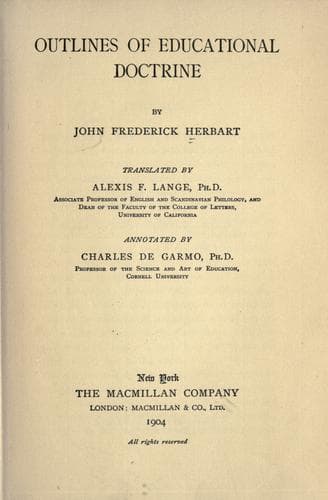
Outlines of Educational DoctrineHerbart, Johann Friedrich
Philosophy
Outlines of Educational Doctrine
Herbart, Johann Friedrich
Education -- Philosophy
Whatever German opinion may be regarding the beginnings of historical
instruction for their own children, American history possesses
strong claims for precedence when we come to children of the United
States. If we regard the chief intellectual purpose of history for
the student to be the understanding of the present status through
a knowledge of the historical progress that has led to it, then
the primitive and pioneer history of this country is infinitely
more valuable than any other to an American child, for in it lie
enfolded the forces that have developed our people; whereas Greece
and Rome are as distant in influence as they are in time. It is the
mythology of Greece and Rome that most attracts children; but this
belongs to literature rather than to history. Accounts of battles
are about the same the world over, but it takes more maturity of
mind to understand the Greek rage for individuality after the rise
of philosophy, than it does to understand a corresponding feeling
among the American pioneers, to say nothing of the desirability of
teaching the latter as a phase of our own development. For reasons
of simplicity, therefore, as well as for psychological nearness and
national importance, American history must take precedence over that
of Greece and Rome for American children.
247. Suppose, now, that detailed stories after the models furnished by
the ancients have won the attention of the pupils; the mere pleasure
of listening to stories can nevertheless not be allowed to determine
continuously the impression to be produced. Condensed surveys must
follow, and a few of the main facts be memorized in chronological order.
The following suggestions will be in place here. The chief events are
to attach themselves in the memory to the memorized dates in such a
way that no confusion can arise. Now, a single date may suffice for
the group of connected incidents constituting one main event; if it
seems necessary to add another, or a third, well and good, but to
keep on multiplying dates defeats the very end aimed at. The more
dates the weaker their effect, on account of the growing difficulty
of remembering them all. In the history of one country dates should
rather remain apart as far as possible, in order that the intervening
numbers may be all the more available for purposes of synchronistic
tabulation, by which the histories of different countries are to be
brought together and connected. The same sparing use should be made of
the facts of ancient geography, but those that are introduced must be
learned accurately.
Public-domain text, read in full here on John Shaqi.
Reviews
Reviews
No reviews yet
Be the first to share your thoughts on this work.
Elsewhere in the archive
Join the Discussion
Join the discussion
Sign in to leave a comment or review.
Sign InorCreate an account