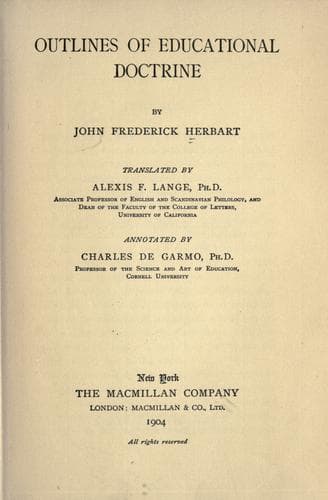
Outlines of Educational DoctrineHerbart, Johann Friedrich
Philosophy
Outlines of Educational Doctrine
Herbart, Johann Friedrich
Education -- Philosophy
Granted that the primitive method of historical narration by the
teacher is the most effective in its appeal to the beginner, it
must be maintained that the combined knowledge and literary skill
of modern historians infinitely surpass the powers of the ordinary
teacher. The modern problem is, not how to compose history, but how
to utilize that which has been composed. It is, in short, to guard
against the confusion that comes from diffuseness. Wide historical
reading may be as bad for the student as wide reading of novels. The
mind may surrender itself to the passing panorama as completely in
the one field as in the other, until the impressions made are like
those of a ship upon a sea. The remedy is the thorough organization
in the mind of the student of the knowledge gained in diverse fields.
This is secured by teacher or author, or both. Some authors secure
clearness of outline by topics, references, and research questions.
Larned’s “History of England” concludes every chapter in this way.
As an illustration we may quote from Chapter XVI, which narrates the
quarrel between King Charles and his people:--
202. _Charles I._
Topic.
1. Charles’s character and views.
References.--Bright, II, 608, 609; Green, 495; Montague, 118;
Ransome, 138, 139.
203. _Bad Faith in the Beginning of the Reign._
Topic.
1. Charles’s marriage and broken pledges.
Reference.--Bright, II, 608, 614.
204. _The First Parliament of King Charles._
Topics.
1. Charles’s designs and his treatment of Parliament.
2. Attitude of Commons and their dissolution.
3. The King’s levies.
Reference.--Gardiner, II, 502, 503.
Research Questions.--(1) What were the legal and illegal sources
of the King’s revenues? (Ransome, 151, 155). (2) What might be
said to constitute the private property of the crown? (3) What
contributed to make Charles’s court expensive? (Traill, IV, 76).
(4) How would this need for money make for parliamentary
greatness?[25]
In a similar way the remaining topics of this section of English
history are recorded, guiding the pupil in his outlines and his
readings. With suitable care on the part of the teacher to see that
the student fixes the outline firmly in mind, there is no danger of
becoming lost in a wilderness of words. At the same time the pupil’s
mind is enriched from many noble sources, instead of being limited by
the presumably meagre resources of a single teacher. By this method
the child may enjoy the benefits of modern erudition, without at the
same time being harmed by dissipation of mental energy.
Public-domain text, read in full here on John Shaqi.
Reviews
Reviews
No reviews yet
Be the first to share your thoughts on this work.
Elsewhere in the archive
Join the Discussion
Join the discussion
Sign in to leave a comment or review.
Sign InorCreate an account