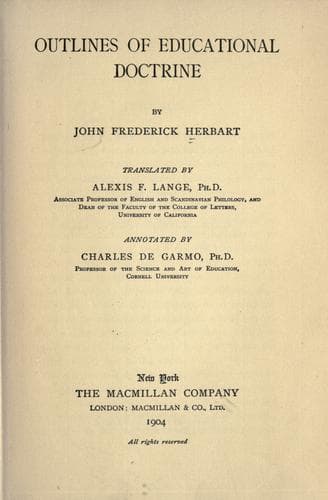
Outlines of Educational DoctrineHerbart, Johann Friedrich
Philosophy
Outlines of Educational Doctrine
Herbart, Johann Friedrich
Education -- Philosophy
“This hasty glance at the development of the subject is sufficient
to show how it has been revolutionized in modern times. To-day it
is progressing as never before. The higher culture is beginning to
affect the lower; determinants have found place in the beginner’s
course; graphic methods, objected to as innovations by some who
are ignorant of their prominence in the childhood of science, are
reasserting their rights; the ‘imaginary’ has become very real;
the inheritances of the algebra-teachers’ guild are being examined
with critical eyes, and many an old problem and rule must soon go
by the board. It is valuable to a teacher to see what changes have
been wrought so that he may join in the movement to weed out the
bad, to cling to the good, and to reach up into the realm of modern
mathematics to see if, perchance, he cannot find that which is good
and usable and light-shedding for the elementary work.”
The true order of elementary mathematics, according to Dr. Smith, is
substantially as follows:--
1. Elementary operations of arithmetic.
2. Simple mensuration, correlation with drawing, the models in
hand:--
Inductive geometry--the primitive form of the science.
3. Arithmetic of business and of science, using the simple equation
with one unknown quantity wherever it throws light upon the
subject.
4. Simple theory of numbers, the roots, series, logarithms.
5. Elementary algebra, including quadratic and radical equations.
6. Demonstrative plane geometry begun before the algebra is
completed and correlated with it.
7. Plane trigonometry and its elementary applications.
8. Solid geometry. Trigonometry. Advanced algebra, with the
elements of differentiation and integration.
“The student should then take a rapid review of his elementary
mathematics, including a course in elementary analytic geometry and
the calculus. He would then be prepared to enter upon the study of
higher mathematics.”
[31] Compare Smith, David Eugene, “History of Modern Mathematics,” in
Merriman & Woodworth’s “Higher Mathematics,” Wiley, New York, 1896.
256. Demonstrations taking a roundabout way through remote auxiliary
concepts are a grave evil in instruction, be they ever so elegant.
Such modes of presentation are rather to be selected as start from
simple elementary notions. For with these conviction does not depend
on the unfortunate condition requiring a comprehensive view of a
long series of preliminary propositions. Thus Taylor’s Theorem can
be deduced from an interpolation formula, and this, in turn, from
the consideration of differences, for which nothing is needed beyond
addition, subtraction, and knowledge of the permutation of numbers.
The following account of imaginary and complex numbers by
Dr. David Eugene Smith is so lucid that it is given at length:--
Public-domain text, read in full here on John Shaqi.
Reviews
Reviews
No reviews yet
Be the first to share your thoughts on this work.
Elsewhere in the archive
Join the Discussion
Join the discussion
Sign in to leave a comment or review.
Sign InorCreate an account