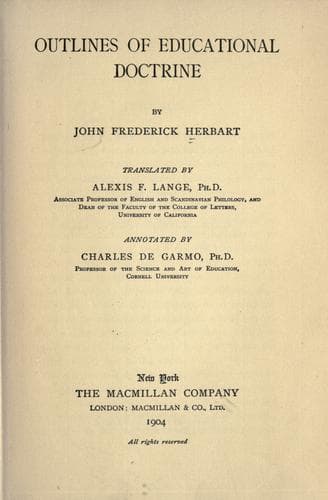
Outlines of Educational DoctrineHerbart, Johann Friedrich
Philosophy
Outlines of Educational Doctrine
Herbart, Johann Friedrich
Education -- Philosophy
255. In schools where practical aims predominate, logarithms should
be explained by a comparison of the arithmetical with the geometrical
series, and the practical application will immediately follow. But even
where recourse is had to Taylor’s Theorem and the Binomial Theorem,
the gain to the beginner will not usually be very much greater. Not
as though these theorems, together with the elements of differential
calculus, could not be made clear; the real trouble lies in the fact
that much of what is comprehended is not likely to be retained in the
memory. The beginner, when he comes to the application, still has the
recollection of the proof and of his having understood it. Indeed, with
some assistance he would be able, perhaps, to again retrace step by
step the course of the demonstration. But he lacks perspective; and in
his application of logarithms it is of no consequence to him by what
method they have been calculated.
What has been said here of logarithms may be applied more generally.
The value of rigid demonstrations is fully seen only when one has made
himself at home in the field of concepts to which they belong.
It is customary in American schools to take up elementary algebra and
elementary geometry upon the completion of arithmetic, both algebra
and geometry being anticipated to some extent in the later stages of
arithmetic. The following paragraphs from the pen of David Eugene
Smith[31] indicate some of the advance in algebra since Herbart’s
time:--
“The great revival of learning known as the Renaissance, in the
sixteenth century, saw algebra take a fresh start after several
centuries of complete stagnation. Tartaglia solved the cubic
equation, and a little later Ferrari solved the biquadratic. By the
close of the sixteenth century Vieta had put the keystone in the
arch of elementary algebra, the only material improvements for some
time to come being in the way of symbolism. For the next two hundred
years the struggle of algebraists was for a solution of the quintic
equation, or, more generally, for a general solution of an equation
of any degree.
“The opening of the nineteenth century saw a few great additions to
the theory of algebra. The first was the positive proof that the
general equation of the fifth degree is insoluble by elementary
algebra, a proof due to Abel. The second was the mastery of the
number systems of algebra,--the complete understanding of the
negative, the imaginary, the incommensurable, the transcendent.
Other additions were in the line of the convergency of series, the
approximation of the real roots of numerical equations, the study of
determinants--all finding their way into the elements, together with
the theories of forms and groups, which must soon begin to influence
the earlier chapters of the subject.
Public-domain text, read in full here on John Shaqi.
Reviews
Reviews
No reviews yet
Be the first to share your thoughts on this work.
Elsewhere in the archive
Join the Discussion
Join the discussion
Sign in to leave a comment or review.
Sign InorCreate an account