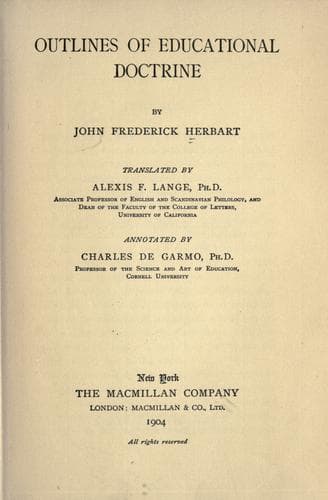
Outlines of Educational DoctrineHerbart, Johann Friedrich
Philosophy
Outlines of Educational Doctrine
Herbart, Johann Friedrich
Education -- Philosophy
Though industriously debated, there is no field of education more
undecided both as to matter and method than nature work in the
grades. Some scientists would teach large amounts of well-classified
knowledge; others are content when they have secured a hospitable
frame of mind toward nature. If a love for flowers and birds can be
cultivated in children, the latter class are satisfied that the best
result has been attained. Thus a discussion arises as to which is the
more valuable, _attitude_ or _knowledge_.
It is feared by some that any attempt to teach real science, even
of an elementary kind, will result in a paralysis of permanent
scientific interest. To this it is replied that a sentimental regard
for æsthetic aspects of nature insures little or no true scientific
interest.
Both sides are, in large measure, wrong; for, though apparently
antagonistic in their aims, they make merely a different application
of a common principle, which, if not wholly erroneous, is at least
inadequate. Both parties assume that the end to be attained in nature
study is something only remotely related to the pupil’s practical
life. One would present nature for its own sake as scientific
knowledge; the other would offer it for its own sake as a source of
æsthetic or other feeling. The scientist often assumes that to a
pupil a scientific fact or law is its own excuse for being. He thinks
there must be a natural, spontaneous response to such a fact or law
in the breast of every properly constituted child, so that, to imbue
the mind with the scientific spirit, it is only necessary to expose
it to scientific fact.
Perhaps, unfortunately for the normal child, this view is somewhat
encouraged by the biographies of scientific geniuses. On the other
hand, those who hold the poetic view of nature assume that there must
be a native response to natural beauties in every child; so that
the true method is to expose him to nature’s beauty, when rapture is
sure to follow. Unfortunately again for the pupil, this view is also
encouraged by the influence of the nature poets. The result is that
natural science is presented as an end in itself--in the one case as
scientific knowledge, in the other as the lovable in nature.
While it may be admitted that a few children will respond now to
the one stimulus, now to the other, the great mass are not thrilled
with rapture at nature’s beauty, nor are they fettered by scientific
interest in her laws. To become an object of growing interest to
children, nature must have a better basis than natural childish
delight in the novel, or reverence for scientific law. The first of
these is evanescent, the second feeble.
We may agree with the scientist as with the poet, that both science
and poetic appreciation are desirable ends, but they cannot be
imparted to the childish mind by didactic fiat.
Public-domain text, read in full here on John Shaqi.
Reviews
Reviews
No reviews yet
Be the first to share your thoughts on this work.
Elsewhere in the archive
Join the Discussion
Join the discussion
Sign in to leave a comment or review.
Sign InorCreate an account