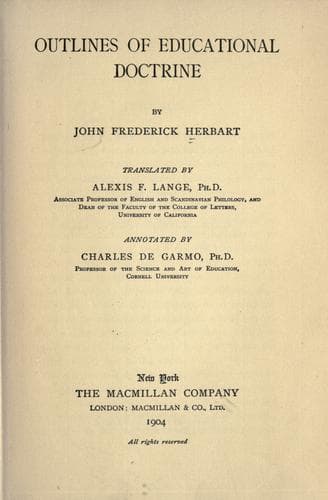
Outlines of Educational DoctrineHerbart, Johann Friedrich
Philosophy
Outlines of Educational Doctrine
Herbart, Johann Friedrich
Education -- Philosophy
If there is one service greater than another that Herbart has
rendered to education, it is in bringing clearly to our consciousness
the supreme importance of the principle of apperception, or mental
assimilation, as a working basis for educative processes. So long
as a fact or a principle or system of knowledge stands as an end
in itself, just so long is it a thing apart from the real mental
life of the child. Even a formally correct method of presentation,
should it even appeal at once to all ‘six’ classes of interest, will
fail to create more than a factitious mental enthusiasm. It is like
conversation that is ‘made’ interesting; it may suffice to lighten a
tedious hour, but it awakens no vital response. When, however, the
natural love of novelty or inborn response to the true is reinforced
by a sense of warm personal relationship, when the facts of forest,
or plain, or mine, or animal life flood the mind with unexpected and
significant revelations concerning either the present or the past in
close personal touch with the learner, then instruction rests upon
an apperceptive basis. Abstractions that before were pale, beauties
that were cold, now receive color and warmth because they get a new
subjective valuation that before was impossible.
A sedate sheep nibbling grass or resting in the shade, a skipping
lamb gambolling on the green, are suitable objects of nature study.
Their pelts, their hoofs, their horns, their wool, are worthy of
note as scientific facts. A diluted interest may even be added by
recitation of the nursery rhymes about “Little Bo-Peep” and “Mary had
a Little Lamb.” But these are devices for the feeble-minded.
If the teacher can reveal to the pupil the function of wool in making
garments for the race, and can lead him to repeat the processes
by which, from time immemorial, the wool has been spun into yarn
and woven into cloth; if, at the same time, the influence of this
industry upon the home life, both of men and women, can be shown, the
study of the sheep becomes worthy the attention even of a boy who
can play foot-ball or of a girl who can cook. The literature of the
sheep is no longer infantile or fatuous. We have a gamut reaching
from Penelope to Priscilla. In the words of Professor Dewey: “The
child who is interested in the way in which men lived, the tools
they had to do with, the transformation of life that arose from the
power and leisure thus gained, is eager to repeat like processes
in his own action; to make utensils, to reproduce processes, to
rehandle materials. Since he understands their problems and their
successes only by seeing what obstacles and what resources they had
from nature, the child is interested in field and forest, ocean and
mountain, plant and animal.... The interest in history gives a more
human coloring, a wider significance, to his own study of nature.”[34]
Public-domain text, read in full here on John Shaqi.
Reviews
Reviews
No reviews yet
Be the first to share your thoughts on this work.
Elsewhere in the archive
Join the Discussion
Join the discussion
Sign in to leave a comment or review.
Sign InorCreate an account