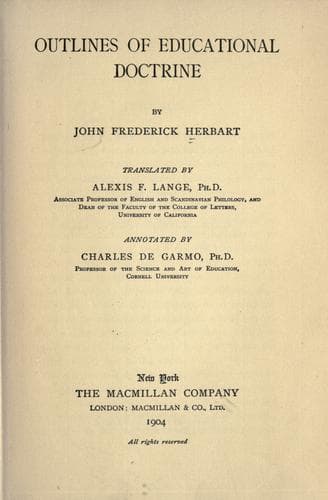
Outlines of Educational DoctrineHerbart, Johann Friedrich
Philosophy
Outlines of Educational Doctrine
Herbart, Johann Friedrich
Education -- Philosophy
287. Where the goal to be reached is technical knowledge and
multiformity of scholarship, each branch of study asserts its claims
to thoroughness without regard to the rest. Such is the attitude of
the state, which requires many men with special training, together
constituting an efficient whole. Hence it disseminates knowledge and
establishes institutions of learning, without inquiring, save with
reference to future official appointments, who the individuals are that
avail themselves of the offered opportunities.
288. The family, on the other hand, interested as it is in the
individual, must take the pedagogical point of view, according to
which every human being is to realize the best he is capable of. It is
essential that families should grasp this distinction, and accordingly
concern themselves, not with greatness of particular achievements, but
with the totality of culture possible for the individual.
289. Closely connected with the foregoing is the difference between
interest and skill. Skill of various sorts can be obtained by force;
but it is of no value to general culture when the corresponding
interest is lacking.
Insistence on this distinction is a sufficient answer to much
uncalled-for criticism and much unwarrantable assumption of superior
knowledge concerning the results of early stages of instruction. These
results, it is charged, are inadequate; if this or that had been
converted earlier into ability to do, greater progress would have been
made. But when interest has not been aroused, and cannot be aroused,
compulsory acquisition of skill is not only worthless, leading as it
does to soulless mechanical activity, but positively injurious, because
it vitiates the pupil’s mental attitude and disposition.
290. Whether the pupil’s individuality will endure without injury the
pressure which drill in skilful performance would necessitate, is a
question which at times cannot be decided except by trial. Reading,
arithmetic, grammar, are familiar instances.
291. The more perfect the instruction, the greater the opportunity it
affords for comparing the excellences and faults of the individuals
receiving it simultaneously. This point is of importance both to the
continuation of instruction and to training; to the latter, because the
teacher’s insight into the causes of the faults which training has to
combat is deepened.
292. The ethical life may attach itself to views embracing the
universe; it may, on the contrary, move within a very narrow range
of thought. Now while it is true that external circumstances will
usually set limits to instruction, its scope should nevertheless not
be narrower, but in every way wider than the realm of necessary,
everyday prudence. Otherwise the individual will always be in danger of
exaggerating his own importance and that of persons closely related to
him.
Public-domain text, read in full here on John Shaqi.
Reviews
Reviews
No reviews yet
Be the first to share your thoughts on this work.
Elsewhere in the archive
Join the Discussion
Join the discussion
Sign in to leave a comment or review.
Sign InorCreate an account